Trend Following Strategy for Forex | PFM Capitals – Prop Firms Passing Service & Funded Account Management
Trusted by 2,500+ Funded Traders

Master the Trend Following Strategy for Forex Trading Success

Discover the most powerful and proven approach to forex trading with trend following. Combined with our expert prop firms passing service and funded account management service, you can achieve consistent profitability in the forex market.

94%
Pass Rate
$12M+
Profits Generated
2,500+
Accounts Passed
Professional forex trader using trend following strategy on multiple monitors - PFM Capitals

Quick Strategy Summary

📊
Difficulty Level
Intermediate
🎯
Profit Target
8%–10%
📉
Daily Drawdown
5% Max
🏆
Best Strategy
Trend Following
⏱️
Est. Passing Time
7–15 Days
Risk Level
Low-Medium

Introduction to Trend Following in Forex Trading

Understanding the foundation of one of the most profitable trading approaches in the financial markets

Trend following is widely recognized as one of the most reliable and profitable trading strategies in the forex market. This approach is based on a simple yet powerful principle: identify the direction of the prevailing market trend and trade in that direction. Rather than trying to predict market reversals or catch exact tops and bottoms, trend followers focus on capturing the meat of the move — the sustained price movements that offer the highest profit potential.

For traders looking to pass prop firm challenges and grow funded accounts, trend following offers an exceptional balance of consistency, risk control, and profitability. This is precisely why our prop firms passing service at PFM Capitals relies heavily on trend following methodologies to deliver consistent results for our clients.

💡 Key Insight: According to research by managed futures and systematic trading funds, trend following strategies have consistently outperformed other approaches over multi-decade timeframes, making it one of the most statistically validated trading methodologies in existence.

Why Traders Search for Trend Following Strategies

The growing popularity of trend following strategy searches reflects several important market dynamics:

  • Rising demand for prop firm trading: More traders are seeking to trade with funded accounts, and trend following is ideal for meeting prop firm profit targets while managing drawdown limits.
  • Need for systematic approaches: Traders are moving away from discretionary and emotional trading toward rules-based, repeatable strategies.
  • Desire for consistency: Unlike scalping or high-frequency trading, trend following offers more predictable and sustainable returns over time.
  • Accessibility for all skill levels: From beginners to professionals, trend following can be adapted to any trader’s experience level and risk tolerance.

At PFM Capitals, we have helped thousands of traders understand and implement trend following strategies successfully. Our funded account management service leverages these same principles to generate consistent profits for funded traders worldwide.

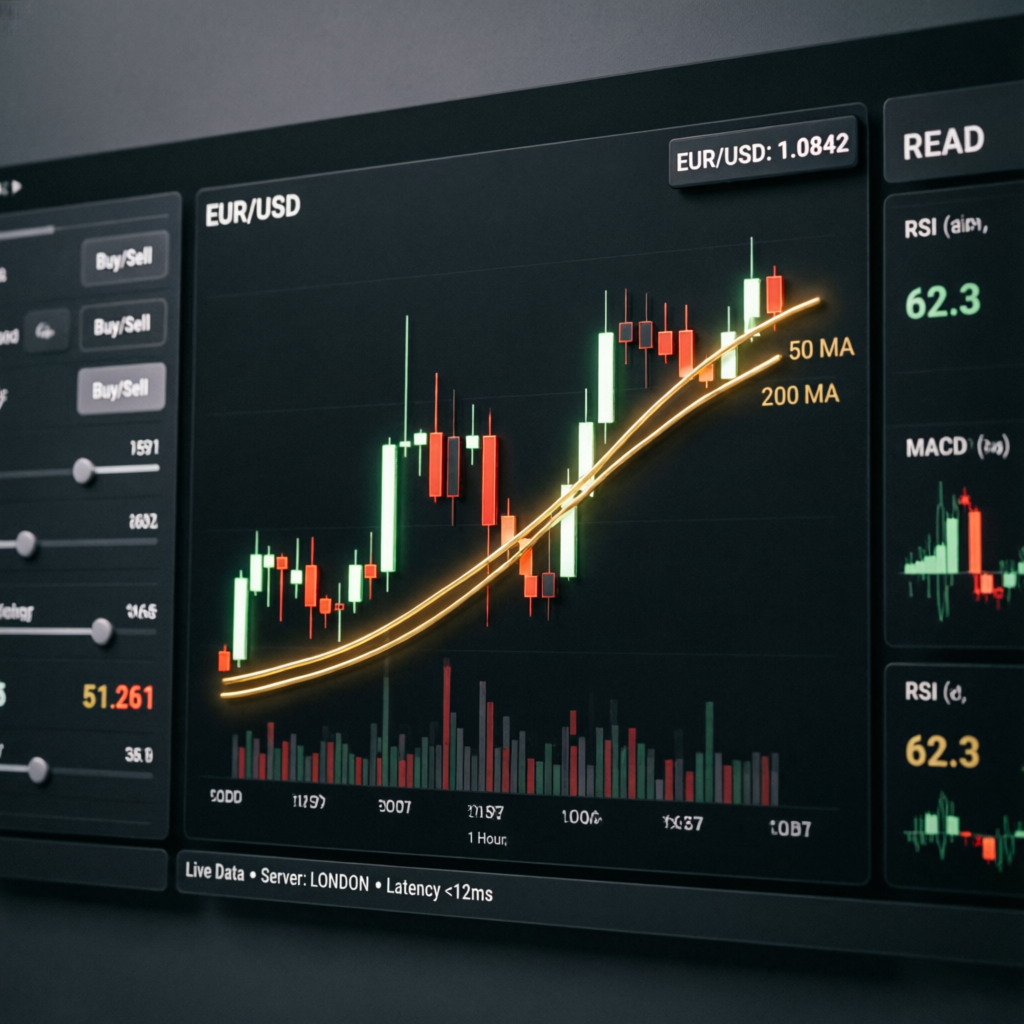
EUR/USD forex chart showing trend following strategy with moving averages and technical indicators
Professional trading team analyzing forex trends and strategies at PFM Capitals
94%
Challenge Pass Rate
1.8%
Avg Risk Per Trade
2.4:1
Avg Risk/Reward
63%
Win Rate

Complete Guide to Trend Following Strategy for Forex

Everything you need to know about implementing trend following in your forex trading and prop firm journey

What Exactly Is Trend Following?

Trend following is a trading methodology that seeks to capture gains through the analysis of an asset’s momentum in a particular direction. The core philosophy is straightforward: when prices are moving in a sustained direction, that movement is likely to continue. Trend followers don’t try to predict where the market will go — they simply follow where the market is already going.

This strategy is particularly effective in the forex market because currency pairs often exhibit strong, sustained trends driven by macroeconomic factors, central bank policies, and global economic conditions. Unlike stocks, which can be influenced by company-specific events, forex trends are typically driven by broader economic forces that create longer-lasting price movements.

📘 Understanding Market Structure: Every forex pair moves through cycles of trending and ranging. Trend following strategies are designed to identify and capitalize on the trending phases, which is where the majority of profitable trading opportunities exist. Our forex account management team at PFM Capitals specializes in identifying these phases with precision.

Key Components of a Trend Following System

A robust trend following system for forex trading consists of several critical components that work together to identify, enter, manage, and exit trades. Understanding each component is essential for building a profitable trading approach, whether you’re trading your own capital or using a prop firms passing service to access funded accounts.

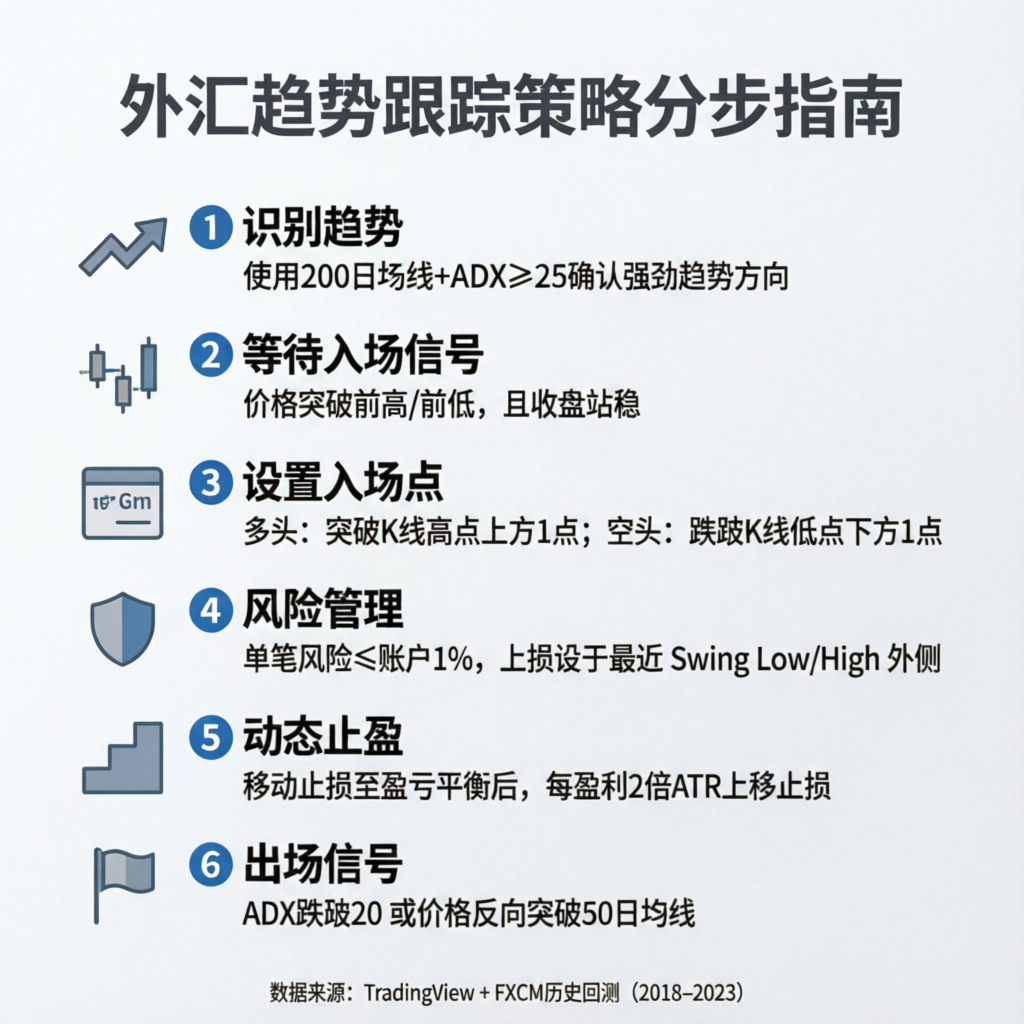
1. Trend Identification

The first step in any trend following strategy is accurately identifying the current market trend. This can be accomplished through several methods:

  • Moving Average Crossovers: Using combinations like the 50-period and 200-period moving averages to identify trend direction. When the shorter MA crosses above the longer MA, it signals an uptrend (golden cross). When it crosses below, it signals a downtrend (death cross).
  • ADX (Average Directional Index): A reading above 25 indicates a strong trend, while readings below 20 suggest a ranging market. Our traders at PFM Capitals use ADX as a primary filter before executing any trend following trades.
  • Higher Highs and Higher Lows: In an uptrend, price consistently makes higher highs and higher lows. In a downtrend, lower highs and lower lows are formed. This price action analysis is fundamental to trend following.
  • Donchian Channels: These channels show the highest high and lowest low over a specified period, providing visual confirmation of trend direction and strength.

2. Entry Signals

Once a trend has been identified, the next step is determining the optimal entry point. Our funded account management service utilizes multiple entry confirmation techniques:

  • Pullback Entries: Waiting for price to pull back to a key moving average or support/resistance level before entering in the direction of the trend.
  • Breakout Entries: Entering when price breaks above a previous high in an uptrend or below a previous low in a downtrend.
  • Momentum Confirmation: Using indicators like RSI or MACD to confirm that momentum supports the trend direction before entering.
  • Multiple Timeframe Confirmation: Confirming the trend direction on higher timeframes (daily or 4-hour) before entering on lower timeframes (1-hour or 30-minute).

3. Exit Strategies

Knowing when to exit a trend following trade is just as important as knowing when to enter. PFM Capitals employs several exit methodologies:

  • Trailing Stop Losses: Moving the stop loss to lock in profits as the trend continues, typically using ATR-based or swing point-based trailing stops.
  • Trend Reversal Signals: Exiting when the trend shows signs of reversal, such as moving average crossovers or ADX dropping below key levels.
  • Time-Based Exits: Closing positions that haven’t moved in the expected direction within a predetermined timeframe.
  • Profit Target Exits: Taking partial profits at predetermined levels while letting a portion of the position run with the trend.
Multiple forex currency pair charts showing trend analysis on trading monitors

Why Trend Following Works in Forex Markets

The forex market is uniquely suited for trend following strategies for several fundamental reasons. Understanding these advantages helps traders appreciate why this approach is so widely used by professional traders and our prop firm services team.

High Liquidity: The forex market trades over $7.5 trillion daily, making it the most liquid financial market in the world. This liquidity ensures that trends can develop and sustain themselves without the erratic price gaps often seen in less liquid markets.

Macro-Driven Movements: Currency trends are driven by macroeconomic factors such as interest rate differentials, economic growth rates, and geopolitical events. These factors tend to create sustained directional moves that trend following strategies are designed to capture.

24-Hour Trading: The forex market operates 24 hours a day, five days a week, allowing trends to develop continuously without the overnight gaps that can disrupt trend following strategies in stock markets.

Leverage Availability: Forex trading offers leverage, which allows trend followers to capitalize on relatively small price movements with meaningful profit potential. Our forex fund management approach carefully manages leverage to maximize returns while controlling risk.

Trend Following vs. Other Trading Strategies

While trend following is our preferred approach at PFM Capitals, it’s important to understand how it compares to other popular trading strategies. Each approach has its own strengths and weaknesses, and the best choice depends on your trading personality, goals, and the specific requirements of your prop firm challenge.

vs. Scalping: Scalping involves making dozens or hundreds of trades per day, capturing very small price movements. While potentially profitable, scalping requires intense focus, fast execution, and carries higher transaction costs. Trend following, by contrast, requires fewer trades with larger profit targets, making it more sustainable and less stressful for most traders.

vs. Mean Reversion: Mean reversion strategies bet that prices will return to their average after extreme moves. While effective in ranging markets, mean reversion can lead to significant losses when strong trends develop. Trend following, on the other hand, thrives in trending environments and avoids the risk of fighting the market.

vs. Price Action Trading: Price action trading focuses on raw price movements and chart patterns without relying heavily on indicators. While trend following can incorporate price action principles, it typically uses indicators to confirm and quantify trend signals. Both approaches can be effective, and our traders often combine elements of both.

For prop firm traders specifically, trend following offers distinct advantages. The fewer number of trades reduces the risk of violating prop firm rules related to trading frequency, and the larger average profit per trade makes it easier to reach profit targets within the evaluation period. This is why our prop firms passing services team prioritizes trend following as the core methodology for challenge completion.

Best Trading Strategies & Techniques

Proven trend following strategies used by PFM Capitals professional traders

1

Multi-Timeframe Trend Confirmation Strategy

This is our flagship strategy at PFM Capitals, used across all our prop firms passing service operations. The approach involves analyzing trends across three timeframes simultaneously to ensure high-probability trade setups.

  • Use the daily chart to identify the primary trend direction
  • Use the 4-hour chart to identify the intermediate trend and key levels
  • Use the 1-hour chart for precise entry timing
  • Only take trades when all three timeframes align in the same direction
  • Entry: Wait for price to pull back to the 20 EMA on the 1-hour chart in the direction of the trend
  • Stop loss: Place below the most recent swing low (for buys) or above swing high (for sells)
  • Take profit: Use a trailing stop of 2x ATR or exit when the 50 MA is breached on the 4-hour chart
2

Donchian Channel Breakout Strategy

Based on the legendary Turtle Trading system, this strategy uses Donchian channels to identify breakouts from established ranges into new trends. Our funded account management service frequently uses this approach for its simplicity and effectiveness.

  • Set up a 20-period Donchian Channel on the 4-hour chart
  • Buy when price breaks above the 20-period high
  • Sell when price breaks below the 20-period low
  • Filter trades using the 200-period moving average — only take buy signals above it, sell signals below it
  • Exit the position when price closes below the 10-period Donchian Channel low (for longs) or above the high (for shorts)
  • Position size: Risk no more than 1.5% of account equity per trade
3

EMA Ribbon Trend Following Strategy

This strategy uses multiple exponential moving averages arranged as a “ribbon” to provide clear visual confirmation of trend direction and strength. It’s particularly effective for prop firm challenges because it provides clear entry and exit signals.

  • Plot 8 EMAs with periods: 5, 10, 15, 20, 25, 30, 35, 40
  • In an uptrend, EMAs will fan out in ascending order (5 above 10 above 15, etc.)
  • In a downtrend, EMAs will fan out in descending order
  • Entry: When EMAs begin to fan out and price is above/below all EMAs
  • Exit: When EMAs begin to converge or cross, indicating trend weakening
  • Best pairs: EUR/USD, GBP/USD, USD/JPY on 1-hour and 4-hour timeframes
4

ADX Trend Strength Filter Strategy

This strategy uses the Average Directional Index to filter trades and ensure we only participate in strong, sustainable trends. It’s a core component of our forex account management methodology.

  • Use ADX with period 14 on the 4-hour chart
  • Only trade when ADX is above 25 (indicating a strong trend)
  • Use +DI and -DI lines to determine trend direction
  • Buy when +DI crosses above -DI and ADX > 25
  • Sell when -DI crosses above +DI and ADX > 25
  • Combine with price action confirmation at key support/resistance levels
  • Trailing stop: Use a Chandelier Exit or ATR-based trailing stop
5

Break and Retest Trend Following Strategy

One of the most reliable price action-based trend following approaches, the break and retest strategy combines support/resistance analysis with trend identification. This is frequently used by our professional traders for prop firm services because of its high win rate and clear risk parameters.

  • Identify the overall trend using higher timeframe analysis
  • Wait for price to break through a key resistance (in uptrend) or support (in downtrend)
  • Wait for price to retest the broken level, which now acts as support/resistance
  • Enter on confirmation candle (bullish engulfing for buys, bearish engulfing for sells)
  • Stop loss: Below the retest level for buys, above for sells
  • Take profit: Next major support/resistance level or use 1:3 risk-reward ratio
Trend following strategy step by step guide infographic showing identification, entry, risk management and exit signals

Risk Management & Position Sizing

Protecting your capital while maximizing profit potential with professional risk management techniques

Risk management is the single most important aspect of any trading strategy, and it’s especially critical when trading prop firm accounts where drawdown rules are strictly enforced. At PFM Capitals, our funded account management service employs institutional-grade risk management protocols to ensure every trade is carefully sized and managed.

Position Sizing Principles

Proper position sizing ensures that no single trade can cause significant damage to your account. Here are the key principles we follow:

  • Fixed Percentage Risk: Risk no more than 1-2% of your account balance on any single trade. For a $100,000 funded account, this means risking $1,000-$2,000 per trade maximum.
  • ATR-Based Position Sizing: Use the Average True Range to determine position size based on current market volatility. Higher volatility = smaller position size.
  • Volatility-Adjusted Risk: Reduce position size during high-impact news events and periods of elevated market volatility.
  • Equity-Based Sizing: Adjust position size based on current account equity rather than starting balance to account for running profits or losses.

⚠️ Prop Firm Rule: Most prop firms have a daily drawdown limit of 5% and a maximum drawdown limit of 10-12%. Your position sizing must account for these limits to ensure you never violate them, even during a series of consecutive losses.

Stop Loss Placement

Effective stop loss placement is crucial for trend following strategies. At PFM Capitals, we use several stop loss methodologies depending on market conditions:

  • ATR-Based Stops: Place stop losses at 1.5x to 2x the ATR value below the entry price for long positions, or above for short positions.
  • Swing Point Stops: Place stops just beyond the most recent swing low (for longs) or swing high (for shorts).
  • Moving Average Stops: Use the 20-period or 50-period EMA as a dynamic stop loss level, adjusting it as the trade progresses.
  • Structure-Based Stops: Place stops beyond key support or resistance levels that, if broken, would invalidate the trade thesis.
Forex trader managing risk with stop loss and position sizing calculations on multiple monitors
📐

Position Size Calculator Formula

Position Size = (Account Risk $) / (Stop Loss in Pips × Pip Value)

Example: For a $100,000 account risking 1% ($1,000) with a 50-pip stop loss on EUR/USD (pip value $10):

Position Size = $1,000 / (50 × $10) = 2.0 lots

🧠 Trading Psychology Tip: One of the biggest challenges in trend following is the emotional difficulty of enduring drawdowns during consolidation periods. Our prop firms passing service traders are trained to maintain discipline and stick to the system even during challenging periods.

Psychology Tips for Trend Following

Successful trend following requires not just technical skill but also emotional discipline. Here are essential psychology tips:

  • Accept Losing Trades: Even the best trend following systems have win rates of 40-60%. Losses are a normal and expected part of the process.
  • Avoid Overtrading: Resist the urge to trade when there are no clear trend signals. Patience is a key virtue in trend following.
  • Don’t Cut Winners Short: One of the biggest mistakes traders make is taking profits too early. Let winning trades run to capture the full trend.
  • Stick to Your Plan: Write down your trading rules and follow them religiously. Emotional decisions are the enemy of consistent profitability.
  • Review and Journal: Keep a detailed trading journal to identify patterns, improve your process, and maintain accountability.

Common Mistakes to Avoid

Trading Against the Trend

Trying to pick tops and bottoms instead of following the established trend direction. This is the #1 mistake that leads to significant losses.

Overleveraging Positions

Using excessive leverage that amplifies losses beyond your risk tolerance. Always calculate position size based on your stop loss distance.

Ignoring Market Context

Trading trend signals without considering the broader market context, economic calendar, and potential news catalysts.

📉

Not Using Stop Losses

Entering trades without predefined exit points. Every trade must have a stop loss to protect your capital and manage risk effectively.

😰

Emotional Trading

Letting fear or greed dictate trading decisions. Following your trading plan consistently is the only way to achieve long-term success.

🔄

Switching Strategies

Abandoning trend following after a few losses and jumping to another strategy. Consistency and patience are essential for trend following success.

Prop Firm Rules & Requirements

Understanding the key rules you need to follow when trading prop firm challenges with trend following strategies

Proprietary trading firms have established specific rules and requirements that traders must follow during the evaluation phase and while managing funded accounts. Understanding these rules is critical for anyone using a prop firms passing service or managing a funded account. Our funded account management service team is well-versed in the rules of all major prop firms and ensures strict compliance.

Rule Category Typical Requirement Trend Following Impact
Daily Drawdown Limit 5% of account balance Position size must be limited so that even a worst-case loss doesn’t exceed 5% in a single day
Maximum Drawdown 10%–12% overall Cumulative losses must never exceed this threshold; requires strict risk management across all trades
Profit Target (Phase 1) 8%–10% of account balance Trend following’s larger average wins make this target achievable within the evaluation period
Profit Target (Phase 2) 5% of account balance Lower target in Phase 2 is easily achievable with consistent trend following execution
Consistency Rules No single trade > 30-50% of total profit Distribute profits across multiple trades rather than relying on one large winner
News Trading Rules Restrictions on trading during high-impact news Avoid entering new positions 2 minutes before and after major news releases (NFP, CPI, FOMC)
Minimum Trading Days 4–5 days minimum Spread trades across multiple days to meet minimum day requirements
Maximum Lot Size Varies by firm (often 100 lots per trade) Trend following typically uses moderate lot sizes, so this is rarely a limiting factor
Weekend Holding Some firms prohibit weekend holding Close or adjust positions before weekend if the firm doesn’t allow holding over weekends
Time Limit 30 days (some firms now offer unlimited) Trend following typically achieves targets within 7-15 days, well within time limits

📌 Important Note: Prop firm rules vary significantly between different firms. Our prop firm services team stays updated on the latest rules for every major prop firm including FTMO, MyForexFunds, The Funded Trader, True Forex Funds, and many others. We ensure full compliance with all specific requirements.

News Trading Considerations

When implementing trend following strategies with prop firm accounts, news trading rules require special attention. Most prop firms restrict trading during high-impact news events such as Non-Farm Payrolls, CPI releases, and central bank announcements. Our approach at PFM Capitals includes:

  • Checking the economic calendar before placing any trades
  • Avoiding new entries 2 minutes before and after high-impact news releases
  • Widening stop losses or reducing position size before scheduled news events
  • Using pending orders with appropriate distance from current price to avoid slippage during news
  • Monitoring real-time news feeds for unexpected announcements

Step-by-Step Process Guide

How to implement trend following strategy and pass your prop firm challenge with PFM Capitals

1

Choose Your Prop Firm & Challenge

Select the prop firm and challenge size that matches your trading goals. Consider factors like profit targets, drawdown limits, trading rules, and payout structures. PFM Capitals can help you choose the best option based on your experience level and objectives. Our prop firms passing service works with all major prop firms.

2

Set Up Your Trading Environment

Configure your trading platform (MetaTrader 4/5, cTrader, etc.) with the necessary indicators for trend following: 50 & 200 EMA, ADX, ATR, and volume indicators. Set up your charts with the appropriate timeframes (4H and D1 for trend analysis, 1H for entries). Ensure your internet connection is stable and reliable.

3

Analyze Market Trends

Begin by analyzing the major currency pairs on the daily timeframe to identify the primary trend direction. Use moving average analysis, ADX readings, and price action to confirm trend direction. Focus on pairs that show clear, established trends rather than choppy, ranging conditions.

4

Wait for Entry Signals

Once you’ve identified a strong trend, wait for the right entry setup. This could be a pullback to a moving average, a breakout from consolidation, or a break-and-retest pattern. Patience is key — don’t force trades when the setup isn’t present. Quality over quantity is the hallmark of successful trend following.

5

Execute with Proper Risk Management

When your entry signal confirms, calculate your position size based on your risk parameters (1-2% risk per trade). Set your stop loss at the appropriate level and enter the trade. Use proper lot sizing to ensure you stay within the prop firm’s daily drawdown limits. Document every trade in your journal.

6

Manage & Monitor Open Positions

Once the trade is active, manage it according to your plan. Move your stop loss to breakeven once the trade moves in your favor by 1R. Trail your stop loss as the trend continues to lock in profits. Avoid the temptation to close winning trades too early — let the trend work for you.

7

Achieve Profit Target & Pass

Continue executing your trend following strategy consistently until you reach the profit target. With our funded account management service, this process is handled by professional traders who have successfully passed hundreds of challenges. Once you pass, you’ll receive your funded account and can begin earning real profits.

Professional forex funded account certificate showing successful prop firm challenge completion by PFM Capitals

Advantages & Disadvantages

A balanced comparison of trend following strategy for prop firm trading

Aspect ✅ Advantages ⚠️ Disadvantages
Profit Potential High — captures large trend moves Requires patience during ranging markets
Win Rate 40-60% with proper risk management Lower win rate than scalping strategies
Risk Management Clear stop loss levels based on structure Whipsaws can trigger multiple stops in choppy markets
Psychological Demand Less stressful — fewer trades to manage Difficult to endure drawdown periods
Prop Firm Compatibility Excellent — meets all requirements easily May need multiple days to reach profit target
Learning Curve Moderate — concepts are straightforward Requires discipline to follow consistently
Time Commitment Low — can check charts 2-3 times daily Requires daily chart review and analysis
Market Conditions Thrives in trending markets Underperforms in ranging/sideways markets
Scalability Highly scalable across multiple pairs Limited opportunities during low-volatility periods
Long-Term Viability Proven over decades by professional traders Requires continuous adaptation to changing markets

💡 Bottom Line: Despite its disadvantages, trend following remains one of the most reliable and profitable approaches for prop firm trading. The key is to combine it with proper risk management and the support of a professional prop firms passing service like PFM Capitals to maximize your chances of success.

Why Choose PFM Capitals

Your trusted partner for prop firm challenges and funded account management

At PFM Capitals, we don’t just offer a service — we offer a partnership in your trading journey. Our prop firms passing service is built on years of professional trading experience, institutional-grade risk management, and a genuine commitment to our clients’ success.

What sets us apart from other service providers is our transparent approach, verified track record, and the fact that we only succeed when you succeed. Every trade our professional traders execute is designed to pass your challenge and grow your funded account profitably using proven strategies like trend following.

Professional trader maintaining calm discipline during market volatility - trading psychology at PFM Capitals

High Success Rate

Our prop firms passing service maintains a 94% success rate across all challenges, backed by thousands of verified passing certificates.

👨‍💼

Professional Traders

Our team consists of full-time professional traders with 5+ years of experience in forex markets and prop firm trading.

Verified Proof

We provide transparent Myfxbook links, passing certificates, and live trading proof for every account we manage.

🛡️

Risk Management

Institutional-grade risk management protocols ensure your account is protected at all times with strict adherence to prop firm rules.

Fast Support

24/7 customer support via Telegram and WhatsApp. Quick response times and dedicated account managers for every client.

Trusted Service

Over 2,500 successful accounts passed and $12M+ in profits generated. Our reputation speaks for itself.

Results & Portfolio

Verified trading results and performance proof from PFM Capitals

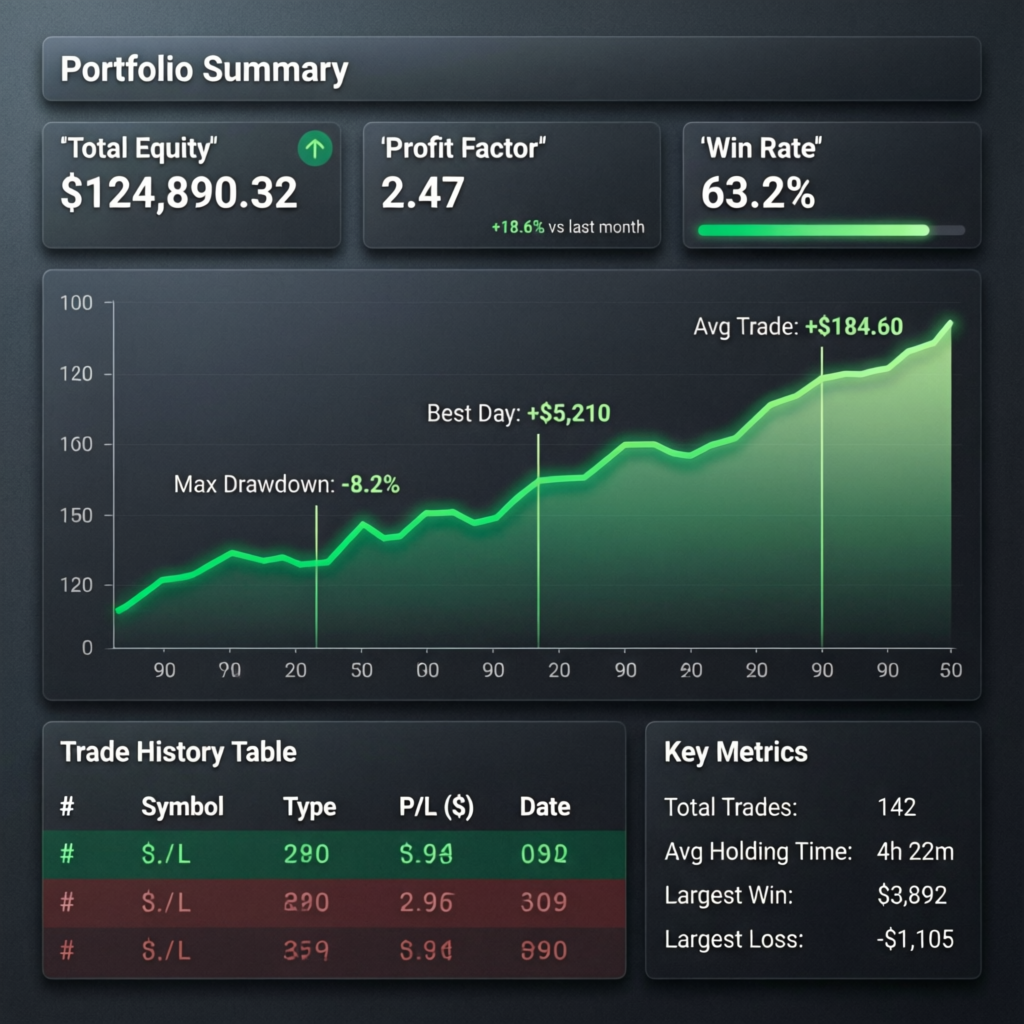
Portfolio summary showing total equity $124,890.32 profit factor 2.47 win rate 63.2% - PFM Capitals trading results

Portfolio Performance

Total Equity: $124,890 | Profit Factor: 2.47 | Win Rate: 63.2% across all managed accounts.

Trader holding PFM Capitals funded account certificate showing successfully completed challenge

Challenge Completion

Successfully completed prop firm challenge with verified certificate. Average passing time: 7-10 trading days.

PFM Capitals premium financial services logo and branding for prop firm passing and funded account management

PFM Capitals Brand

Premium Financial Services — Forex Trading & Proprietary Firm Management. Trusted by thousands worldwide.

📊 Want to see more verified results? Contact us on Telegram or WhatsApp for Myfxbook links and live trading proof from our prop firms passing service.

Client Reviews

What our clients say about our prop firm passing service and funded account management

Frequently Asked Questions

Everything you need to know about trend following strategy and our prop firm services

Ready to Pass Your Prop Firm Challenge?

Let PFM Capitals handle your prop firm challenge with our expert prop firms passing service. With a 94% success rate and verified proof of results, we’re your best partner for funded account success.

️ Risk Disclaimer

Trading foreign exchange on margin carries a high level of risk and may not be suitable for all investors. Past performance is not indicative of future results. The high degree of leverage can work against you as well as for you.

Before deciding to trade foreign exchange, you should carefully consider your investment objectives, level of experience, and risk appetite. The possibility exists that you could sustain a loss of some or all of your initial investment.

PFM Capitals provides trading services and educational content. We do not guarantee profits or specific results. All trading decisions should be made based on your own research and risk tolerance. Please consult with a licensed financial advisor before making any investment decisions.

Prop firm rules and requirements may change without notice. Always verify current rules with the specific prop firm before trading. Results mentioned on this page are based on past performance and do not guarantee future outcomes.

Scroll to Top