Master the art of swing trading to pass prop firm evaluations and manage funded accounts profitably. Learn from professional traders at PFM Capitals.
A comprehensive overview of what you need to know about swing trading for prop firm success.
Swing trading is one of the most popular and effective trading strategies used by professional traders worldwide. It involves holding positions for a period ranging from several days to a few weeks, capturing the “swings” or medium-term price movements in financial markets. Unlike day trading, which requires constant screen monitoring, or position trading, which may hold trades for months, swing trading strikes the perfect balance between active engagement and strategic patience.
For traders seeking to pass prop firm evaluations, swing trading has emerged as the go-to strategy for good reason. Prop firms like FTMO, MyForexFunds, The5%ers, and others set specific profit targets and strict drawdown limits that require traders to be both profitable and disciplined. Swing trading allows you to achieve the required profit targets while maintaining the risk management discipline that prop firms demand.
When traders search for “swing trading strategy explained,” they are typically looking for actionable, step-by-step guidance on how to apply this approach to real trading scenarios — especially in the context of prop firms passing services and funded account management services. They want to understand not just the theory, but the practical execution that leads to consistent profitability.
Why do so many traders gravitate toward swing trading? The answer lies in its unique advantages: it reduces the stress of constant monitoring, minimizes the impact of market noise and micro-fluctuations, allows for more thorough analysis before entering trades, and provides a better risk-to-reward ratio compared to scalping or day trading. For prop firm traders specifically, these benefits translate directly into a higher probability of passing challenges and maintaining funded accounts over the long term.
At PFM Capitals, we specialize in helping traders leverage swing trading strategies to pass their prop firm evaluations. Our prop firms passing service has helped thousands of traders achieve their funding goals, and our funded account management service ensures that once funded, traders can maximize their earning potential through professional-grade forex account management.
Understanding swing trading at a deep level is essential for anyone serious about passing prop firm evaluations and building a sustainable trading career. This comprehensive guide breaks down every aspect of swing trading, from market analysis to trade execution, specifically tailored for prop firm environments.
Swing trading operates primarily on the H4 (4-hour), D1 (daily), and W1 (weekly) timeframes. These timeframes provide the optimal balance between signal reliability and trade frequency. The daily chart is particularly favored by prop firm traders because it filters out most of the market noise while still providing enough trading opportunities to meet profit targets within the evaluation period.
When analyzing the daily chart, swing traders look for key structural elements: higher highs and higher lows in uptrends, lower highs and lower lows in downtrends, and clear support and resistance zones. These structural markers serve as the foundation for all swing trading decisions and are crucial for prop firm services that require consistent, rule-based trading approaches.
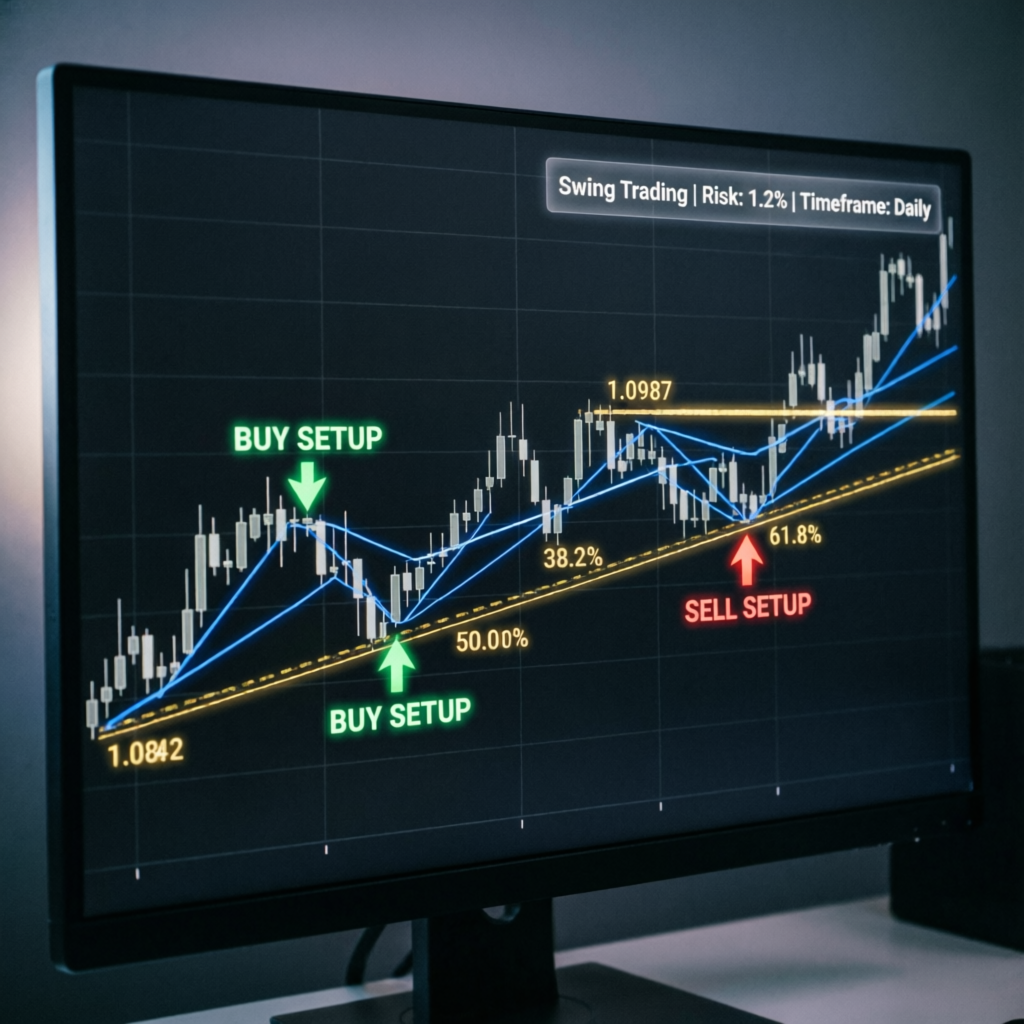
Market structure is the backbone of swing trading. Before entering any trade, a swing trader must understand the broader context in which the market is moving. This involves identifying the dominant trend, recognizing key support and resistance levels, and understanding where price is likely to move next.
At PFM Capitals, our traders use a multi-timeframe analysis approach. They start with the weekly chart to identify the primary trend, move to the daily chart for intermediate structure, and then use the H4 chart for precise entry timing. This top-down approach ensures that every trade aligns with the broader market direction, significantly increasing the probability of success — a critical factor when working with funded account management services.
Price action is the purest form of market analysis, relying solely on the movement of price itself rather than lagging indicators. Swing traders who master price action can read the market like a book, identifying key patterns and setups that signal high-probability trading opportunities.
Key price action patterns used in swing trading include:
While price action is the foundation, certain technical indicators can enhance swing trading analysis. The most effective indicators for swing trading include:
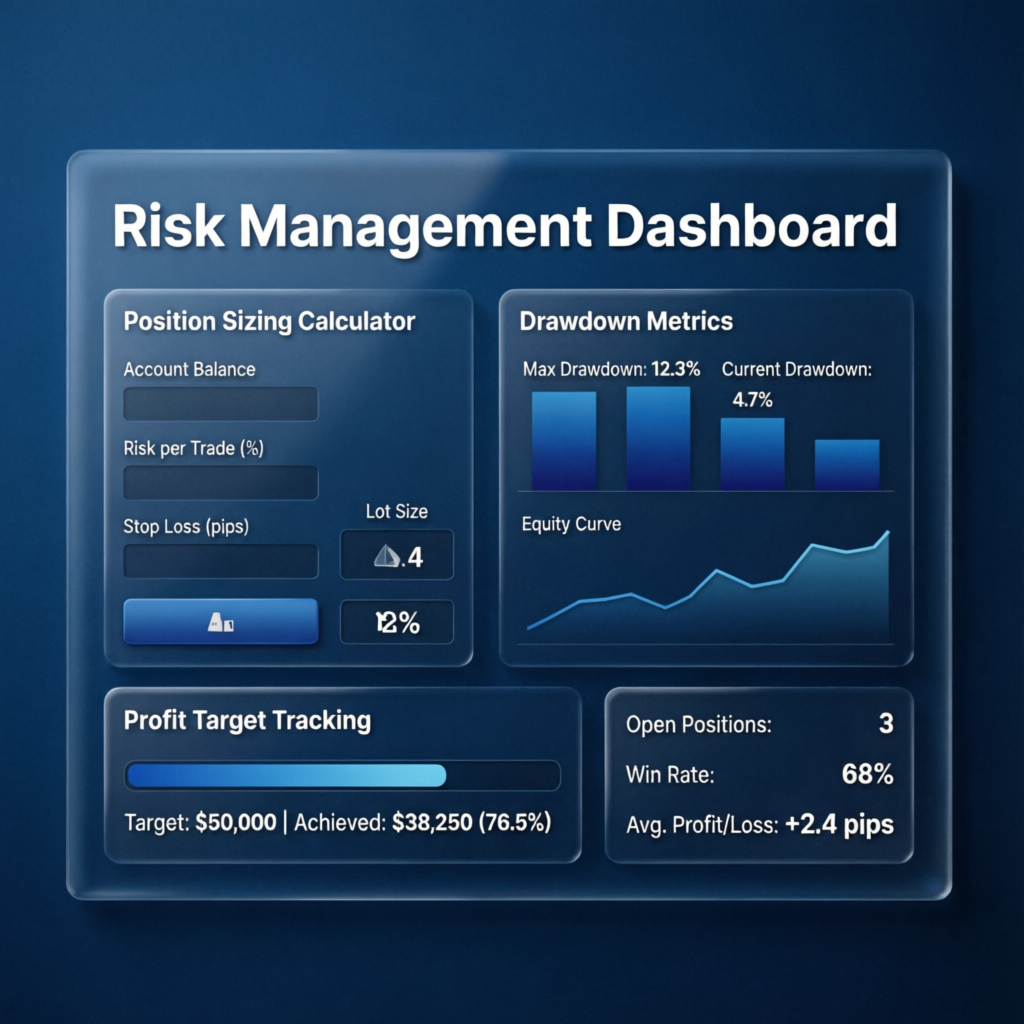
No swing trading strategy is complete without robust risk management. In the context of prop firm evaluations, risk management is not just important — it is absolutely critical. A single poorly managed trade can violate drawdown rules and result in account termination.
The golden rule of swing trading risk management is to never risk more than 1-2% of your account balance on a single trade. For a $100,000 funded account, this means risking no more than $1,000 to $2,000 per trade. This disciplined approach ensures that even a string of losses won’t come close to the maximum drawdown limits set by prop firms.
Proper position sizing is the mathematical foundation of risk management. Before entering any swing trade, you must calculate the appropriate lot size based on your stop loss distance and risk percentage. The formula is straightforward:
Position Size = (Account Balance × Risk Percentage) ÷ Stop Loss in Pips × Pip Value
For example, if you have a $50,000 account, risk 1% ($500), and your stop loss is 50 pips on EUR/USD (where 1 pip = $10 for a standard lot), your position size would be 1 standard lot. This calculation ensures that your risk remains consistent across all trades, regardless of the instrument or stop loss distance.
Successful swing trading requires well-defined entry and exit criteria. Entries should only be taken when multiple confluence factors align: the trade direction matches the dominant trend, price is at a key support or resistance level, a recognizable candlestick pattern has formed, and risk-reward ratio is at least 1:2.
Exits should be managed using a combination of trailing stops and fixed take-profit levels. A common approach is to close 50% of the position at the first target (1:2 risk-reward) and let the remaining 50% run with a trailing stop to capture extended moves. This approach locks in profits while allowing for additional gains.

Not all markets are created equal for swing trading. The best markets for swing trading are those with clear trends, sufficient liquidity, and manageable volatility. For forex traders, the major pairs — EUR/USD, GBP/USD, USD/JPY, and AUD/USD — are ideal because they offer tight spreads, deep liquidity, and well-defined trends.
Commodity indices like gold (XAU/USD) and oil (WTI/CL) also provide excellent swing trading opportunities due to their trending nature. Stock indices such as the S&P 500, NASDAQ, and DAX are popular choices for swing traders who prefer index CFDs. At PFM Capitals, our prop firms passing service focuses primarily on major forex pairs and gold, as these instruments provide the most consistent swing trading setups.
While swing trading doesn’t require constant screen monitoring, timing your entries around key trading sessions can significantly improve your results. The London session (3 AM – 12 PM EST) and the New York session (8 AM – 5 PM EST) offer the highest liquidity and volatility, making them ideal for swing trade entries. The overlap between London and New York (8 AM – 12 PM EST) is particularly powerful, often producing the strongest daily candlestick patterns.
Swing traders should avoid entering new positions during low-liquidity periods such as the Asian session (unless trading JPY pairs) or during major holiday periods when market behavior can be unpredictable and unreliable.
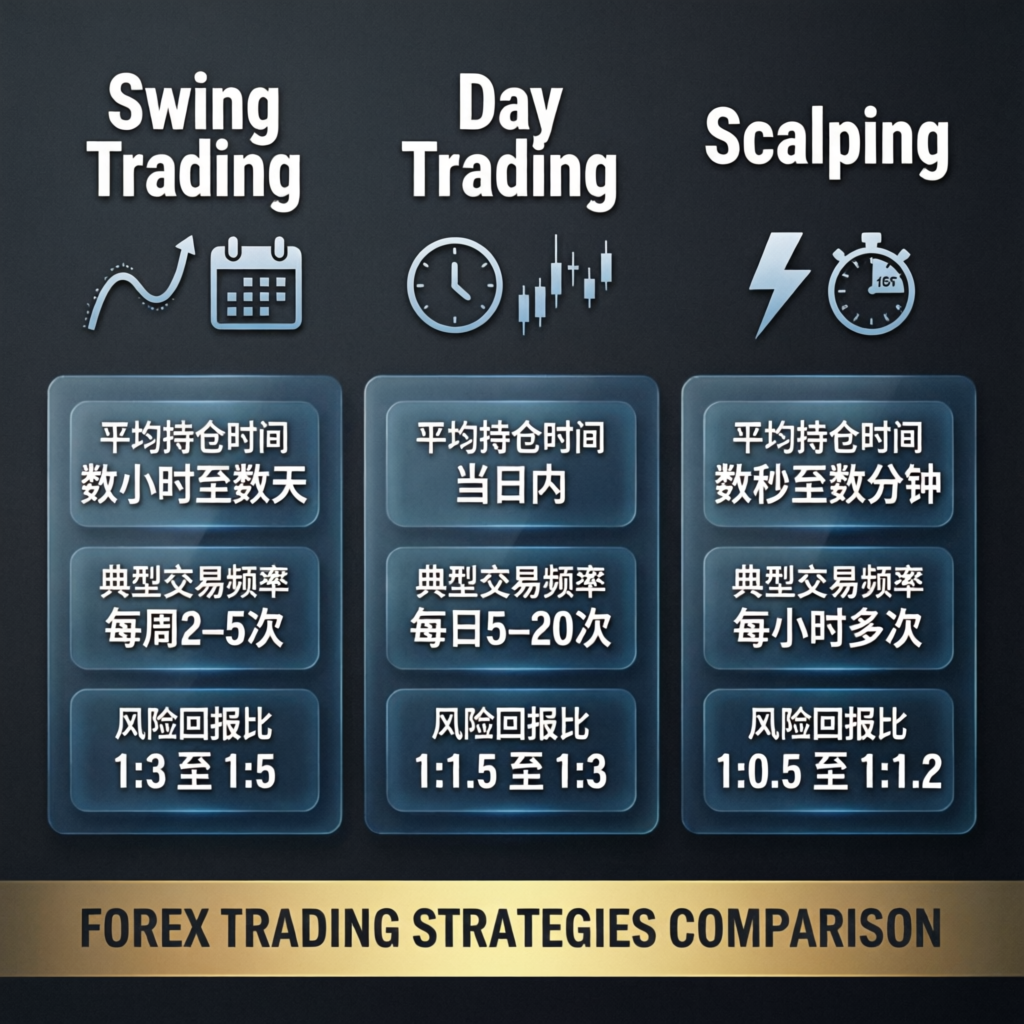
Having a well-defined trading strategy is the difference between consistent profitability and random gambling. In the world of prop firm services, traders need strategies that are not only profitable but also consistent, repeatable, and aligned with the specific rules of each prop firm. Below are the most effective swing trading strategies used by professional traders at PFM Capitals.
This is the most reliable swing trading strategy for prop firm evaluations. The concept is simple: identify the dominant trend on the daily chart, wait for price to pull back to a key support (in an uptrend) or resistance (in a downtrend) level, and enter in the direction of the trend when a reversal candlestick pattern confirms the pullback is complete.
Key Rules:
Markets tend to respect historical support and resistance levels. This strategy involves identifying major horizontal levels on the daily chart where price has reversed multiple times in the past, and entering trades when price approaches these levels showing signs of rejection.
Key Rules:
When price breaks through a significant support or resistance level, it often continues in the breakout direction. However, the most reliable entries occur when price breaks, pulls back to retest the broken level (which now acts as support in an uptrend or resistance in a downtrend), and then continues in the breakout direction.
Key Rules:
While many traders dismiss moving averages as lagging indicators, they can be powerful tools when used correctly in swing trading. The 50-period and 200-period exponential moving averages (EMAs) on the daily chart provide clear trend direction signals and dynamic support/resistance levels.
Key Rules:
Regardless of which strategy you use, the following risk management rules are non-negotiable for prop firm success:
Even the best strategy will fail without proper psychological discipline. Here are the key psychological principles that separate successful swing traders from the rest:
Every prop firm has specific rules that traders must follow during the evaluation phase and while managing a funded account. Understanding these rules is critical because violating even one can result in immediate account termination. At PFM Capitals, our prop firms passing service is designed to navigate these rules with precision.
| Rule | Phase 1 | Phase 2 | Funded Account |
|---|---|---|---|
| Profit Target | 8% – 10% | 5% | N/A |
| Daily Drawdown | 5% | 5% | 5% |
| Maximum Drawdown | 10% | 10% | 10% |
| Minimum Trading Days | 5 days | 5 days | N/A |
| Consistency Rule | Yes | Yes | Yes |
| News Trading Allowed | Varies | Varies | Varies |
| Time Limit | 30 days (some unlimited) | 60 days | None |
| Profit Split | N/A | N/A | 70% – 90% |
The daily drawdown rule is the most critical rule in any prop firm evaluation. Most firms set this at 5% of the initial account balance, calculated from the highest equity point of the day. This means if your account starts at $100,000 and grows to $102,000 during the day, your daily drawdown limit becomes $102,000 × 5% = $5,100. Your equity must not fall below $96,900 at any point during that trading day.
For swing traders, this means you must carefully calculate your position sizes to ensure that even if price moves against you, you won’t breach the daily drawdown limit. A general rule is to never have more than 2% of your account at risk from open positions at any given time.
The maximum drawdown rule (typically 10% of the initial account balance) is calculated from the starting balance and acts as a hard stop. If your account equity falls below $90,000 on a $100,000 account, the account is terminated. This rule emphasizes the importance of consistent risk management and avoiding large drawdowns during the evaluation phase.
Many prop firms implement consistency rules to ensure that traders aren’t relying on a single lucky trade to pass the evaluation. A typical consistency rule requires that no single trade contributes more than 30-50% of the total profit needed to pass. This encourages traders to take multiple high-quality trades rather than gambling on one big position.
Some prop firms restrict trading during high-impact news events such as Non-Farm Payrolls (NFP), Consumer Price Index (CPI) releases, and central bank interest rate decisions. These events can cause extreme price spikes that may trigger stop losses or breach drawdown limits. If your prop firm allows news trading, be extra cautious and reduce position sizes during these events. At PFM Capitals, our traders typically avoid entering new positions 30 minutes before and after major news releases.
Following a structured process is essential for prop firm success. Here is the exact step-by-step process used by PFM Capitals traders to consistently pass prop firm evaluations and manage funded accounts profitably.
Research and choose a prop firm that aligns with your trading style. Consider factors such as profit targets, drawdown limits, trading rules, profit split, and reputation. Popular options include FTMO, The5%ers, True Forex Funds, and MyFundedFX. At PFM Capitals, we can guide you to the best prop firm for your specific needs through our prop firm services.
Read and understand every rule of the evaluation phase. Know the profit target, daily drawdown, maximum drawdown, minimum trading days, consistency requirements, and any restrictions on trading styles or news trading. Write these rules down and keep them visible during your trading sessions.
Create a detailed trading plan that includes your strategy, entry/exit criteria, risk management rules, and daily routine. Your plan should specify which instruments you’ll trade, what timeframes you’ll analyze, how many trades you’ll take per day, and what your maximum daily loss will be.
Before risking real money on an evaluation, practice your strategy on a demo account that mirrors the prop firm’s conditions. Trade for at least 2-4 weeks on demo to confirm that your strategy is profitable and that you can follow your trading plan consistently.
Begin the evaluation phase by risking only 0.5% per trade for the first few trades. This allows you to build a buffer and gain confidence without putting your account at significant risk. Once you have a comfortable buffer above your starting balance, you can increase to the standard 1% risk per trade.
Stick to your trading plan religiously. Only take trades that meet all your entry criteria. If no setup is available, don’t trade. Patience is your greatest weapon. Remember that there is no time limit on many modern prop firms, so rushing is unnecessary.
Never risk more than 1% per trade. Track your daily drawdown carefully. If you hit 2% daily loss, stop trading for the day. Never move your stop loss. Never add to losing positions. These rules are non-negotiable and are the foundation of long-term trading success.
Once you pass Phase 1, approach Phase 2 with the same discipline. The profit target is typically lower (5%), but the rules remain the same. After passing Phase 2, you’ll receive your funded account and can begin earning real profits. At this point, consider using PFM Capitals’ funded account management service to maximize your earnings.
Every trading strategy has its strengths and weaknesses. Understanding both sides of swing trading will help you make an informed decision about whether it’s the right approach for your trading goals and personality.
| Factor | Swing Trading | Day Trading | Scalping |
|---|---|---|---|
| Timeframe | Daily / H4 | M15 – H1 | M1 – M5 |
| Holding Period | Days to weeks | Minutes to hours | Seconds to minutes |
| Trades per Day | 0–2 | 3–10 | 20–100+ |
| Risk per Trade | 1–2% | 0.5–1% | 0.1–0.5% |
| Risk-Reward | 1:2 to 1:5 | 1:1 to 1:3 | 1:0.5 to 1:1.5 |
| Screen Time | 30 min – 2 hrs | 4–8 hrs | Full session |
| Stress Level | Low–Medium | High | Very High |
| Best for Prop Firms | ⭐⭐⭐⭐⭐ | ⭐⭐⭐ | ⭐⭐ |
PFM Capitals is a leading prop firms passing service and funded account management service provider, trusted by thousands of traders worldwide.
Our experienced traders maintain an industry-leading 94% success rate in passing prop firm evaluations. We don’t just trade — we deliver results consistently across all major prop firms.
Our team consists of seasoned traders with 5+ years of experience in forex markets. Each trader is vetted, tested, and proven before being assigned to client accounts.
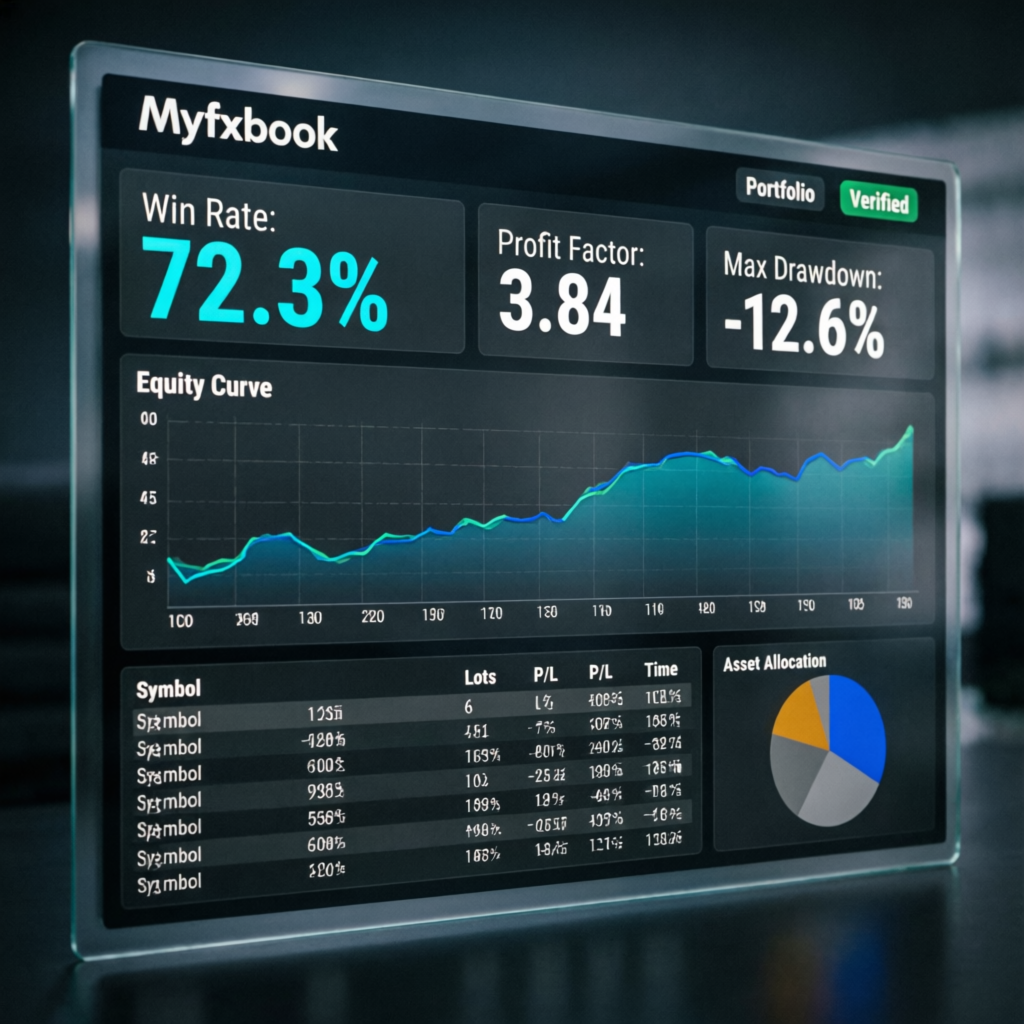
All our trading results are verified through Myfxbook and other third-party verification services. We provide transparent, auditable performance records for every account.
Our proprietary risk management system ensures that every trade is calculated to stay well within prop firm drawdown limits. We prioritize capital preservation above all else.
Our dedicated support team is available around the clock via Telegram and WhatsApp. Get instant answers to your questions and real-time updates on your account status.
With clients in over 50 countries, PFM Capitals has built a reputation as one of the most reliable prop firm services in the industry. Your trust is our greatest asset.
Transparent, verified performance data from our forex account management team.
Completed in 18 trading days using swing trading strategy.
Consistent monthly profits from a managed funded account.
Passed Phase 1 and Phase 2 with conservative risk management.
Real reviews from real traders who used our prop firms passing services and funded account management services.
“PFM Capitals’ prop firms passing service is absolutely incredible. They passed my FTMO $200K challenge in just 12 days. I couldn’t believe how professional and consistent their trading was. Highly recommend their funded account management service too!”
“I was struggling to pass my prop firm evaluation for months. After trying PFM Capitals’ prop firms passing service, they passed it on the first attempt. Their forex account management team is top-notch. Best decision I ever made.”
“The funded account management service from PFM Capitals has been a game-changer for me. They manage my $100K funded account with incredible consistency. I’ve been receiving monthly payouts for 6 months straight. Truly professional.”
“I was skeptical at first, but PFM Capitals delivered beyond my expectations. Their prop firm services helped me get funded with a $50K account, and now I’m earning consistent profits. The swing trading strategy they use is brilliant.”
“PFM Capitals passed my MyFundedFX evaluation in record time. Their team is responsive, professional, and results-oriented. I’ve now moved on to their funded account management service and couldn’t be happier with the results.”
“The best prop firms passing service I’ve ever used. PFM Capitals not only passed my evaluation but also provided detailed reports and updates throughout the process. Their risk management is exceptional. 10/10 would recommend.”
“I’ve tried multiple prop firm services before, but PFM Capitals is in a league of its own. Their forex fund management approach is disciplined, transparent, and profitable. They’ve helped me build a sustainable income from trading.”
“Pass My Prop Firms with PFM Capitals was the easiest decision I’ve made. They handled everything professionally and kept me updated throughout. Now I have a funded account that’s generating consistent profits every month.”
“Outstanding service from PFM Capitals. Their swing trading approach is perfect for prop firm challenges. They passed my $100K FTMO challenge with a 12% profit in just 3 weeks. Their funded account management service is equally impressive.”
“PFM Capitals is the real deal. I was failing prop firm evaluations consistently until I found their prop firms passing service. They passed my challenge and now manage my funded account. I’m earning more in a month than I used to make in a year.”
“The team at PFM Capitals is incredibly professional. Their forex account management service has transformed my trading career. They handle all the trading while I focus on growing my business. Couldn’t ask for better results.”
“I recommend PFM Capitals to every trader looking for a reliable prop firms passing service. They’re transparent, professional, and deliver results. My FTMO account was passed in under 2 weeks with minimal risk. Absolutely phenomenal.”
“PFM Capitals’ funded account management service is world-class. They’ve been managing my $200K funded account for 8 months and have delivered consistent returns every single month. The profit splits have been amazing.”
“After failing 3 prop firm evaluations on my own, I turned to PFM Capitals. They passed my challenge on the first try using their proven swing trading strategy. Now I’m a funded trader earning consistent income. Thank you, PFM Capitals!”
“PFM Capitals offers the best prop firm services in the market. Their team is knowledgeable, responsive, and results-driven. They passed my $50K challenge and now manage the funded account. I’m extremely satisfied with everything.”
“The forex fund management team at PFM Capitals is exceptional. They’ve helped me scale from a $50K to a $400K funded account in just 6 months. Their disciplined approach to swing trading and risk management is unmatched in the industry.”
“I can’t say enough good things about PFM Capitals. Their prop firms passing service saved me hundreds of dollars in failed evaluation fees. They passed my challenge quickly and professionally. Their funded account management is equally outstanding.”
“PFM Capitals is my go-to for all prop firm needs. Whether it’s passing a new challenge or managing my existing funded accounts, they deliver consistently. Their swing trading strategy is perfectly suited for prop firm environments. Highly recommended!”
“Working with PFM Capitals has been a life-changing experience. Their forex account management service has given me the financial freedom I always dreamed of. Professional, reliable, and incredibly profitable. 5 stars across the board.”
“PFM Capitals’ pass my prop firms service is the best investment I’ve made in my trading career. They passed my $100K challenge in 15 days and now manage the account with consistent monthly profits. If you want results, go with PFM Capitals.”
Everything you need to know about swing trading, prop firm evaluations, and our prop firms passing service.
Join 2,800+ traders who trust PFM Capitals for professional prop firms passing services and funded account management.