How Leverage Works in Forex: The Complete Guide for Traders
Master the mechanics of forex leverage, understand its impact on your trading capital, and learn how to use leverage effectively within prop firm evaluations. Whether you’re looking for prop firms passing services or professional funded account management services, this guide gives you everything you need to succeed.
Understanding Forex Leverage: Your Gateway to Funded Trading Success
A comprehensive breakdown of how leverage works in forex trading and why mastering it is essential for passing prop firm evaluations and managing funded accounts successfully.
Forex leverage is one of the most powerful—and misunderstood—tools available to retail and professional traders alike. At its core, leverage allows you to control a larger trading position than your actual account balance would normally permit. This amplification effect is what makes the foreign exchange market one of the most accessible financial markets in the world, enabling traders with relatively small capital to participate in positions worth hundreds of thousands of dollars.
For traders seeking prop firm passing services, understanding leverage is not just an academic exercise—it’s a survival skill. Proprietary trading firms impose strict drawdown limits, profit targets, and risk management requirements that directly interact with the leverage you use. A single poorly leveraged trade can breach your daily drawdown limit and disqualify you from an evaluation, costing you both time and money.
Why do so many traders search for information about leverage in forex? Because the gap between knowing leverage exists and knowing how to use it effectively is where most trading accounts fail. According to industry data, approximately 70-80% of retail forex traders lose money, and excessive leverage is consistently cited as one of the primary reasons. Traders who successfully pass prop firm evaluations and maintain funded account management services have one thing in common: they understand leverage as a tool to be managed, not a weapon to be wielded recklessly.
This guide will walk you through every aspect of forex leverage—from the fundamental mechanics to advanced strategies used by professional fund managers. Whether you’re a complete beginner trying to understand what 1:100 leverage actually means, or an experienced trader looking to optimize your leverage usage within prop firm constraints, you’ll find actionable insights here that can directly improve your trading performance.
💡 Key Insight: Leverage doesn’t change the market—it changes your exposure to it. The same 50-pip move in EUR/USD will generate vastly different profit or loss amounts depending on your leverage and position size. Understanding this relationship is the foundation of successful forex account management.
At PFM Capitals, we’ve helped thousands of traders navigate the complex world of prop firm evaluations and funded account management. Our experience has shown us that the traders who succeed are not necessarily the ones with the most aggressive strategies—they’re the ones who understand how leverage, risk, and position sizing work together to create consistent, sustainable returns.
Before diving into strategies and prop firm specifics, it’s essential to build a rock-solid understanding of leverage mechanics. This section covers everything from basic definitions to the nuanced ways leverage interacts with your trading account equity, margin requirements, and overall risk profile.
What Is Leverage in Forex Trading?
Leverage in forex trading is essentially a loan provided by your broker that allows you to open positions larger than your deposited capital. It’s expressed as a ratio—such as 1:50, 1:100, or 1:500—indicating how many units of currency you can control for each unit of your own capital.
For example, with 1:100 leverage, every $1 in your account gives you the buying power to control $100 worth of currency. If you have a $5,000 account and 1:100 leverage, you could theoretically control a position worth $500,000. This magnification is what makes forex trading accessible to traders without massive capital reserves.
However—and this is critical—leverage is a double-edged sword. The same mechanism that amplifies your profits also amplifies your losses. A 1% price move against a leveraged position at 1:100 leverage would result in a 100% loss of the margin used for that trade. This is why experienced traders who use prop firm services never max out their available leverage.
Leverage in forex: A 10:1 ratio means $100 of margin controls $1,000 in trading position size
How Leverage Works: The Mechanics
Understanding leverage requires grasping several interconnected concepts:
1. Margin and Leverage Relationship
Margin is the collateral required to open and maintain a leveraged position. It’s directly tied to your leverage ratio. With 1:100 leverage, the margin requirement is 1% of the position size. So a $100,000 position requires $1,000 in margin. Your broker holds this margin as security against potential losses.
2. Available Margin vs. Used Margin
Your account has two margin states: used margin (the amount locked in open positions) and available margin (what’s left for new trades). As your positions move in your favor, your available margin increases. As they move against you, it decreases. When available margin reaches zero, you cannot open new positions.
3. Margin Level and Margin Call
Margin level is calculated as (Equity Used Margin) × 100. Most brokers issue a margin call when this level drops to 100%, meaning your equity equals your used margin. If the market continues moving against you and margin level drops further, positions may be automatically closed (stop-out) to prevent your account from going negative.
📊 Leverage Calculation Example: With a $10,000 account and 1:50 leverage, you can control up to $500,000 in positions. However, smart funded account management recommends using only 10-20% of available leverage, meaning your actual controlled position should be $50,000-$100,000 to maintain proper risk management.
Leverage Ratios Explained
Different brokers and prop firms offer varying leverage ratios. Here’s what each commonly means for your trading:
Leverage Ratio
Margin Required
$10,000 Account Buys
Risk Level
1:1 (No Leverage)
100%
$10,000
Very Low
1:10
10%
$100,000
Low
1:30
3.33%
$300,000
Moderate
1:50
2%
$500,000
Moderate-High
1:100
1%
$1,000,000
High
1:200
0.5%
$2,000,000
Very High
1:500
0.2%
$5,000,000
Extreme
Why Leverage Matters for Prop Firm Traders
If you’re using prop firms passing services to obtain funded accounts, leverage takes on additional significance. Prop firms typically cap leverage at specific levels (often 1:30 to 1:100), and they enforce drawdown rules that make leverage management a critical success factor.
Consider this scenario: You’re in a $100,000 prop firm evaluation with a 5% daily drawdown limit ($5,000). If you use excessive leverage and a single trade moves 50 pips against you on a standard lot (worth $500 per pip), you’ve just lost $25,000—far exceeding your daily drawdown limit. Proper leverage usage would involve sizing positions so that even adverse movements stay well within your drawdown thresholds.
This is precisely where professional funded account management services add tremendous value. Experienced fund managers at firms like PFM Capitals understand how to calibrate leverage and position sizing to maximize profit potential while staying safely within prop firm risk parameters.
Leverage and Pip Value
The relationship between leverage and pip value is fundamental to forex trading. A pip (percentage in point) is the smallest price movement in a currency pair. For most pairs, one pip equals 0.0001. The value of a pip depends on your position size, which is directly influenced by leverage.
With a standard lot (100,000 units), one pip typically equals $10. With a mini lot (10,000 units), one pip equals $1. With a micro lot (1,000 units), one pip equals $0.10. Your leverage determines how many lots you can open with your available margin, which in turn determines your per-pip exposure.
Professional traders using forex account management services always calculate their pip value before entering any trade. This ensures they know exactly how much each pip movement costs or earns them, allowing precise risk management aligned with prop firm rules.
⚙️ Mechanics
Leverage Mechanics & Calculations: A Deep Dive
Now that you understand the basics, let’s explore the mathematical mechanics behind leverage. This section will help you calculate exactly how leverage affects your positions, margin requirements, and potential returns.
Margin Requirement Formula
The margin required for any position is calculated using this formula:
Margin = (Position Size × Current Price) ÷ Leverage Ratio
For example, if you want to open a position of 1 standard lot (100,000 units) of EUR/USD at a price of 1.0850 with 1:100 leverage:
Margin = (100,000 × 1.0850) ÷ 100 = $1,085
This means you need $1,085 in your account to open this position. Your remaining capital stays available for other trades or as a buffer against losses.
Effective Leverage vs. Available Leverage
There’s an important distinction between the leverage your broker offers (available leverage) and the leverage you actually use (effective leverage). Available leverage is the maximum ratio your account permits. Effective leverage is the ratio based on your actual open positions relative to your account equity.
Effective Leverage = Total Position Value ÷ Account Equity
If you have $10,000 in equity and open positions totaling $200,000, your effective leverage is 1:20—even if your broker offers 1:100. Smart traders focus on managing their effective leverage, not their available leverage.
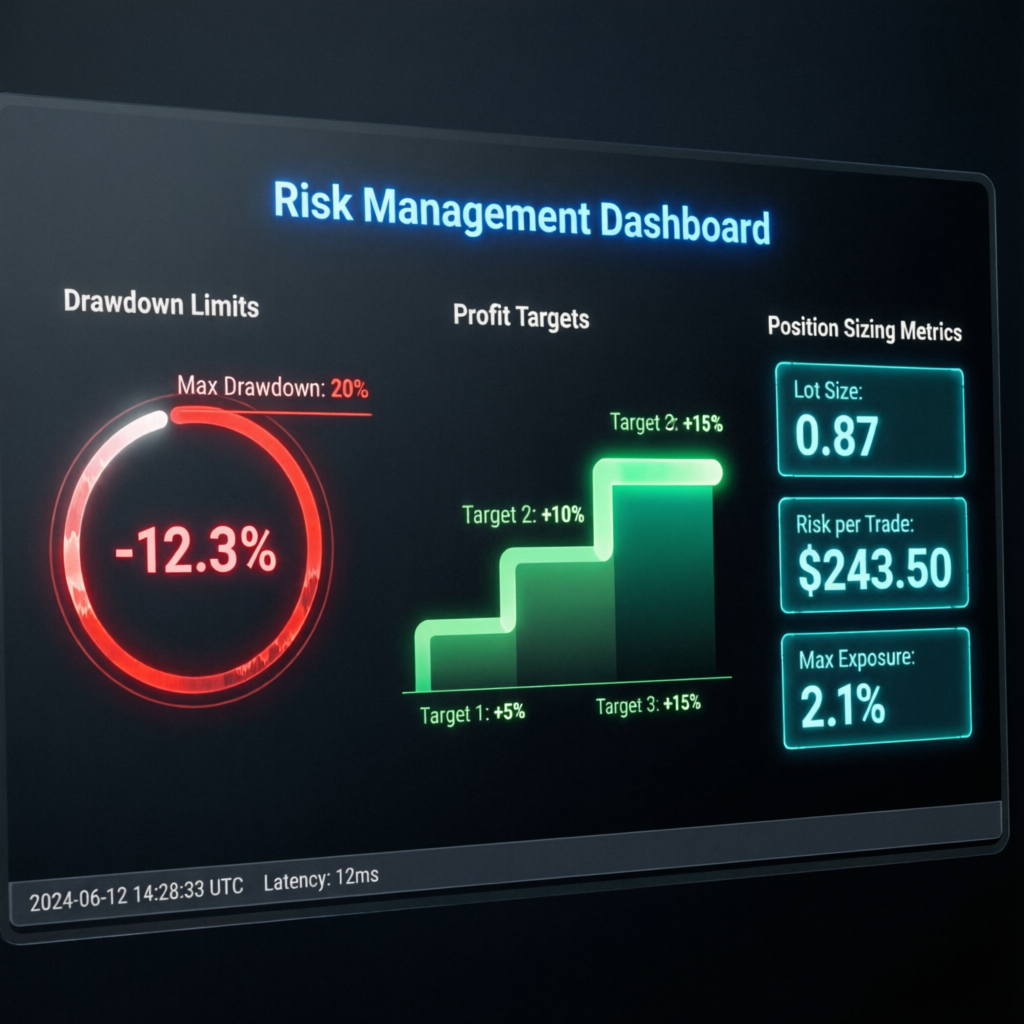
Risk management dashboard: Real-time monitoring of drawdown limits, profit targets, and position sizing metrics essential for prop firm trading
Leverage Impact on Returns
Let’s illustrate how leverage amplifies returns with a practical example. Assume you have a $5,000 account and EUR/USD moves 100 pips in your favor:
Scenario
Position Size
Pip Value
Profit (100 pips)
% Return on Account
No Leverage
0.05 lots
$0.50
$50
1%
1:10 Leverage
0.5 lots
$5.00
$500
10%
1:50 Leverage
2.5 lots
$25.00
$2,500
50%
1:100 Leverage
5.0 lots
$50.00
$5,000
100%
As you can see, leverage dramatically amplifies returns. But the same table applies in reverse if the market moves against you. This is why disciplined position sizing and stop-loss placement are non-negotiable for anyone serious about prop firm services.
Leverage in Different Market Conditions
Leverage behaves differently depending on market conditions. During high-volatility periods—such as major economic news releases, geopolitical events, or market openings—price swings can be significantly larger. Using the same leverage during volatile periods as during calm periods can lead to unexpected losses.
Professional traders using pass my prop firms services typically reduce their position sizes during high-volatility events. This dynamic approach to leverage management is a hallmark of experienced fund managers who understand that market conditions should dictate risk exposure, not just available leverage.
⚠️ Important: Leverage and Swap Rates
When you hold leveraged positions overnight, you may incur or receive swap (rollover) fees. These fees are based on the interest rate differential between the two currencies in your pair and the size of your leveraged position. Higher leverage means larger positions, which means larger swap fees. For swing traders holding positions for multiple days, swap costs can significantly impact profitability. Always factor swap rates into your trading plan, especially when managing funded accounts with strict profit targets.
Strategies
Best Trading Strategies Using Leverage in Forex
Understanding leverage is only half the battle. The other half is knowing how to apply it within effective trading strategies. Below, we outline the most proven strategies used by professional traders who consistently pass prop firm evaluations and generate sustainable returns on funded accounts.
1
Price Action Trading with Leverage
Price action trading focuses on reading raw price movements without relying heavily on indicators. This approach is particularly effective for prop firm trading because it produces clear entry and exit signals with defined risk levels.
Identify key support and resistance levels on higher timeframes (H4, Daily)
Enter with conservative leverage (1:10 to 1:30 effective leverage)
Place stop-loss below/above the signal candle
Target 2:1 or 3:1 risk-to-reward ratio
2
Trend Following Strategy
Trend following is one of the most time-tested strategies in forex. By identifying and trading in the direction of established trends, you can use leverage to amplify gains while maintaining lower risk through trend-aligned entries.
Use moving averages (50 EMA, 200 EMA) to identify trend direction
Enter on pullbacks to the moving average in the trend direction
Use moderate leverage to allow for larger position sizes within trend trades
Trail stop-loss to protect profits as the trend extends
Avoid counter-trend trading during prop firm evaluation phases
Technical analysis chart: EMA crossovers, RSI, and MACD indicators used in trend following strategies with leverage management
3
Breakout Trading Strategy
Breakout trading involves entering positions when price breaks through established support or resistance levels. This strategy can be highly profitable with leverage because breakouts often lead to sustained directional moves.
Identify consolidation ranges or chart patterns (triangles, rectangles, flags)
Wait for a confirmed breakout with increased volume
Enter in the breakout direction with defined stop-loss
Use leverage conservatively—breakouts can also produce false signals
Consider the time of day; breakouts during London/New York overlap are most reliable
4
Scalping with Leverage
Scalping involves taking many small profits throughout the trading day. This strategy requires quick execution, tight spreads, and careful leverage management. It’s popular among prop firm traders because frequent small wins can accumulate to meet profit targets efficiently.
Trade during high-liquidity sessions (London, New York)
Use 1-minute to 5-minute charts for entry signals
Target 5-15 pips per trade with tight stop-losses
Higher leverage is acceptable because positions are held briefly
Requires discipline and emotional control—overtrading is the biggest risk
5
Swing Trading with Moderate Leverage
Swing trading captures medium-term price movements over several days to weeks. This strategy works well for funded account traders who need to demonstrate consistency over time rather than aggressive short-term gains.
Analyze daily and 4-hour charts for trade setups
Use fundamental analysis alongside technical signals
Apply moderate leverage (1:10 to 1:20) to manage overnight risk
Factor in swap costs for multi-day positions
Set wider stop-losses to accommodate natural price fluctuations
️ Risk Management
Risk Management, Position Sizing & Trading Psychology
Risk management is the single most important skill a forex trader can develop. No matter how skilled you are at reading charts or identifying setups, poor risk management will eventually destroy your account. This is especially true when trading with leverage in prop firm evaluations, where drawdown limits are unforgiving.
The 1% Rule: Your Foundation
The golden rule of risk management in leveraged forex trading is simple: never risk more than 1-2% of your account balance on a single trade. For a $100,000 funded account, this means your maximum risk per trade should be $1,000-$2,000.
This rule exists because even the best trading strategies experience losing streaks. If you risk 5% per trade and experience five consecutive losses, your account is down 25%. If you risk 1% per trade and experience five consecutive losses, you’re only down 5%. The 1% rule ensures survival during inevitable drawdown periods.
Position Sizing Formula
Proper position sizing is how you implement the 1% rule with leverage. Here’s the formula:
Position Size = (Account Balance × Risk %) ÷ (Stop Loss in Pips × Pip Value)
Example: $100,000 account, 1% risk ($1,000), 50-pip stop loss on EUR/USD (pip value = $10 per standard lot):
Position Size = $1,000 ÷ (50 × $10) = 2.0 standard lots
This calculation ensures that if your stop loss is hit, you lose exactly 1% of your account—regardless of the leverage available to you. This is how professional funded account management services protect client capital while pursuing consistent returns.
Maximum Drawdown Management
Prop firms enforce both daily and maximum drawdown limits. Understanding these limits and how leverage interacts with them is crucial:
Drawdown Type
Typical Limit
Description
Leverage Impact
Daily Drawdown
3%–5%
Maximum loss allowed in a single trading day
High leverage can breach this in minutes
Maximum Drawdown
8%–12%
Maximum total loss from starting balance
Cumulative losses from over-leveraged trades
Trailing Drawdown
Variable
Drawdown limit that trails your account high
Requires profit protection strategies
Consistency Rule
Varies by firm
Limits on single-trade contribution to profit
Prevents gambling with high leverage
Trading Psychology and Leverage
The psychological impact of leverage cannot be overstated. When you’re trading with leveraged positions, the emotional swings are amplified alongside the financial ones. A $500 swing in a non-leveraged account might feel manageable. The same swing in a leveraged account representing $50,000 in controlled value can trigger fear, greed, and impulsive decisions.
Here are key psychological principles for trading with leverage:
Accept losses as part of the process: Even with a 60% win rate, you’ll experience losing streaks. Leverage magnifies these losses emotionally.
Stick to your plan: Never increase position sizes after a loss (revenge trading) or after a win (overconfidence).
Use leverage as a tool, not a thrill: If you’re trading for excitement, you’re gambling—not trading.
Take breaks: After hitting daily drawdown limits, step away. Emotional trading after losses leads to cascading mistakes.
Journal everything: Document your leverage usage, position sizes, and emotional state for every trade.
⚠️ Common Mistake: Many traders fail prop firm evaluations not because they lack skill, but because they increase leverage after early losses, trying to “make back” money quickly. This approach almost always leads to breaching drawdown limits. Professional prop firms passing services like PFM Capitals use systematic approaches that prevent this psychological trap.
Correlation Risk and Leverage
When you trade multiple currency pairs with leverage, you may unknowingly create correlated risk. For example, going long on EUR/USD and GBP/USD simultaneously is effectively doubling your exposure to the US dollar. If the dollar strengthens, both positions lose. Understanding currency correlations is essential when managing leveraged portfolios.
Professional forex account management teams at PFM Capitals use correlation matrices to ensure that combined leveraged positions don’t create unintended risk concentrations. This level of portfolio management is what separates professional fund management from retail trading.
📜 Rules & Requirements
Prop Firm Leverage Rules & Trading Requirements
Every proprietary trading firm has specific rules regarding leverage, drawdown, profit targets, and trading behavior. Understanding these rules before you begin an evaluation is essential for success. Here’s a comprehensive breakdown of the most common prop firm requirements and how leverage interacts with each one.
Leverage Limits by Prop Firm
Different prop firms offer different maximum leverage levels. Here’s a comparison of leverage offerings across popular prop firms:
Prop Firm Type
Max Leverage
Profit Target
Daily Drawdown
Max Drawdown
Type A (Standard)
1:100
8% Phase 1, 5% Phase 2
5%
10%
Type B (Conservative)
1:30
10% Phase 1, 5% Phase 2
4%
8%
Type C (Aggressive)
1:200
6% Single Phase
5%
12%
Type D (Instant Funding)
1:50
No challenge
5%
10%
Daily Drawdown Rules
The daily drawdown rule is typically the most challenging constraint for new traders. It limits how much you can lose in a single trading day, calculated either from your starting daily balance or from your equity high during the day. Understanding which calculation method your prop firm uses is critical because it affects your leverage decisions.
Balance-based daily drawdown: Calculated from your account balance at the start of the trading day. This is generally more favorable for traders because unrealized profits don’t affect the calculation.
Equity-based daily drawdown: Calculated from your highest equity point during the day. This is more restrictive because if you’re up $3,000 and then lose $4,000, you’ve breached a 5% daily drawdown on a $100,000 account—even though you’re only down $1,000 from the start of the day.
News Trading Rules
Many prop firms restrict trading around major economic news events. These restrictions typically include:
No opening new positions 2 minutes before or after high-impact news releases
No holding positions through major news events (NFP, CPI, FOMC)
Reduced leverage during news trading windows
Some firms allow news trading but with stricter drawdown monitoring
At PFM Capitals, our prop firms passing services team carefully monitors the economic calendar and adjusts trading activity accordingly to ensure full compliance with each prop firm’s news trading policies.
Consistency Rules
Many prop firms now enforce consistency rules that limit how much of your total profit can come from a single trade or single trading day. For example, if the consistency rule states that no single day can contribute more than 30% of your total profit, and you need $8,000 to pass, no single day’s profit can exceed $2,400.
This rule directly impacts leverage usage because it prevents traders from using maximum leverage on a single trade to quickly hit profit targets. Instead, it encourages steady, consistent trading—exactly the approach that PFM Capitals’ professional traders employ.
📌 Pro Tip: Leverage Calibration for Prop Firms
The optimal leverage for prop firm trading is typically 1:10 to 1:30 effective leverage, even if the firm offers 1:100. This provides sufficient buying power while maintaining a comfortable buffer against drawdown limits. Our funded account management service consistently uses this calibrated approach to achieve high pass rates.
Minimum Trading Days
Most prop firms require a minimum number of trading days before you can request a payout or pass an evaluation. This typically ranges from 3-5 trading days. This rule exists to ensure that profits are generated through consistent trading rather than a single lucky trade. When planning your leverage strategy, factor in the minimum trading days requirement to ensure you can meet profit targets within the allowed timeframe.
📋 Process
Step-by-Step Guide: Leverage Mastery for Prop Firm Success
Follow this systematic process to develop leverage mastery that will help you pass prop firm evaluations and manage funded accounts profitably. This step-by-step framework has been refined through thousands of successful funded trader journeys at PFM Capitals.
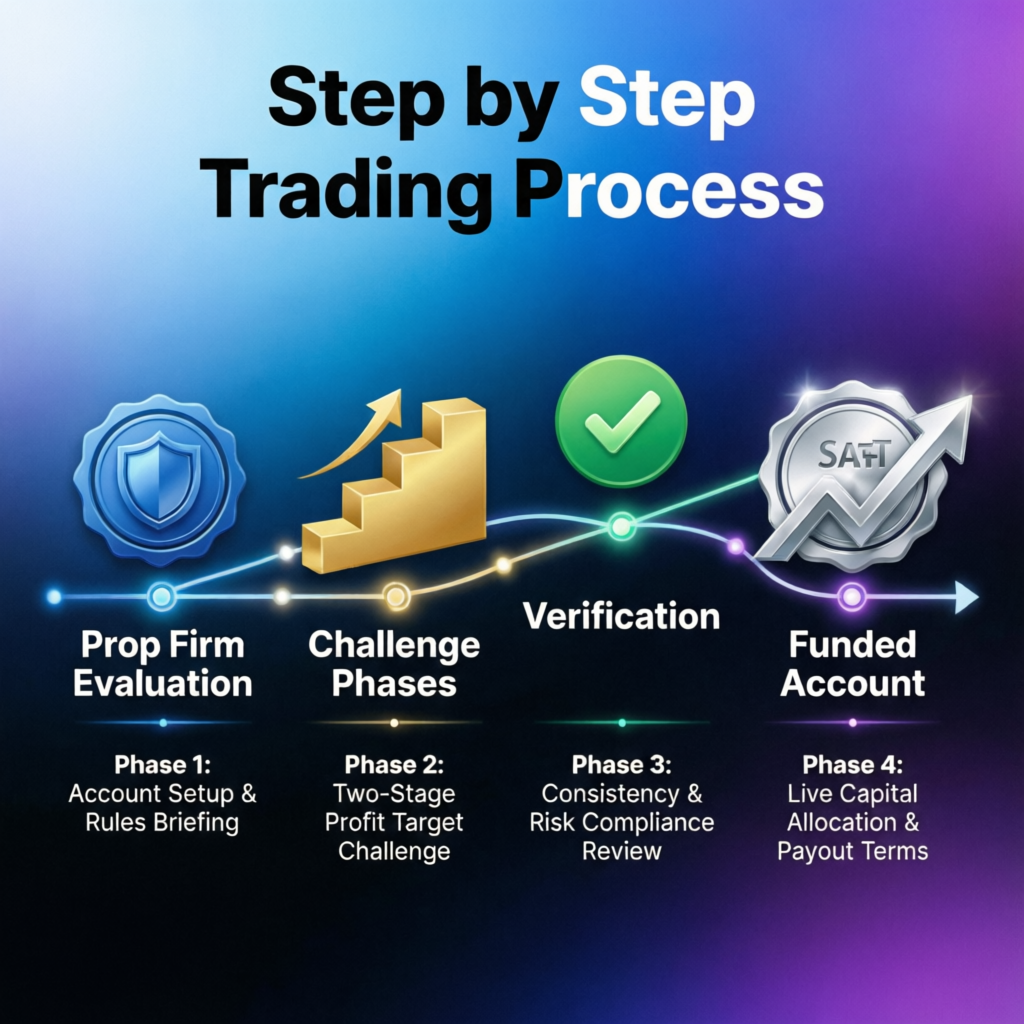
Step-by-step trading process: From prop firm evaluation through challenge phases to funded account allocation
Choose the Right Prop Firm and Account Size
Research prop firms and select one that aligns with your trading style and risk tolerance. Consider the leverage offered, drawdown rules, profit targets, and payout structure. Don’t automatically choose the largest account—start with a size you can manage comfortably. PFM Capitals can help you identify the best prop firm match for your profile through our prop firm services.
Set Your Leverage Parameters
Before placing your first trade, determine your maximum effective leverage. For most prop firm evaluations, we recommend capping effective leverage at 1:20 to 1:30. Calculate your position sizes based on the 1% risk rule and your stop-loss distance. Write down these parameters and commit to them before you start trading.
Develop Your Trading Plan
Create a detailed trading plan that specifies your strategy, entry criteria, exit criteria, position sizing rules, and daily profit/loss limits. Your plan should explicitly state how you’ll use leverage in different market conditions. Include rules for when to reduce position sizes (high volatility, news events) and when to increase them (strong trend confirmation).
Practice on Demo with Prop Firm Rules
Before committing real money, practice your strategy on a demo account configured with the same leverage, drawdown rules, and profit targets as your target prop firm. Trade for at least 2-4 weeks on demo to build confidence and refine your approach. This practice phase is crucial for developing the muscle memory of proper leverage management.
Begin Your Evaluation Phase
Start your prop firm evaluation with discipline. Trade small in the first few days to understand how the platform calculates drawdown in real-time. Gradually increase position sizes as you gain confidence, but never exceed your pre-defined leverage parameters. Focus on consistency over speed—there’s no rush to hit the profit target.
Monitor and Adjust Daily
Review your trading performance at the end of each day. Track your leverage usage, drawdown proximity, and profit progress. Adjust your approach if needed, but never abandon your core risk management rules. If you’re close to daily drawdown limits, stop trading for the day. Preserve your account for tomorrow.
Pass the Evaluation and Transition to Funded
Once you pass the evaluation, the leverage management principles remain the same—but now you’re trading with real profit-sharing implications. Many traders fail during the funded phase because they change their approach. Stick to the same leverage parameters and risk management rules that got you funded. PFM Capitals’ funded account management services can take over account management at this stage if you prefer professional handling.
Scale and Optimize
As you build a track record of consistent profits, you can gradually optimize your leverage usage. This might involve slightly increasing position sizes on high-probability setups or exploring additional currency pairs. Always maintain your core risk management framework. Successful scaling is about incremental improvement, not radical change.
️ Comparison
Advantages & Disadvantages of Forex Leverage
Like any financial tool, leverage has both significant advantages and serious disadvantages. Understanding both sides is essential for making informed decisions about how to use leverage in your forex trading and prop firm journey.
✅ Advantages
Amplifies profit potential from small price movements
Makes forex trading accessible with limited capital
Enables portfolio diversification across multiple pairs
Allows participation in institutional-sized markets
Efficient use of trading capital
Can accelerate profit target achievement in prop firm challenges
Facilitates hedging strategies across correlated pairs
No interest charges on most forex leverage (unlike stock margin)
❌ Disadvantages
Amplifies losses proportionally to profits
Can trigger margin calls and forced liquidation
Increases emotional stress and impulsive decisions
May lead to overtrading and excessive risk-taking
Can breach prop firm drawdown limits quickly
Swap costs are magnified with larger positions
Slippage impact is greater on leveraged positions
Requires advanced risk management skills
Leverage vs. No Leverage: Detailed Comparison
Factor
With Leverage (1:50)
Without Leverage (1:1)
Capital Required
$2,000 controls $100,000
$100,000 controls $100,000
Profit Potential
High (amplified)
Low (proportional)
Loss Risk
High (amplified)
Low (proportional)
Prop Firm Compatibility
Essential for most challenges
Limited applicability
Accessibility
High (low entry barrier)
Low (high capital needed)
Risk Management Need
Critical
Important but less urgent
Psychological Pressure
High
Low
Suitability for Beginners
Requires education first
More forgiving
💡 Bottom Line: Leverage is neither good nor bad—it’s a tool. The outcome depends entirely on how you use it. Traders who use prop firms passing services from experienced providers like PFM Capitals benefit from professional leverage management that maximizes the advantages while mitigating the disadvantages.
With hundreds of service providers in the prop firm space, choosing the right partner for your prop firm passing service and funded account management service needs is a critical decision. Here’s why thousands of traders trust PFM Capitals:
Trust & Security: PFM Capitals is built on integrity and backed by verified trading expertise
📈
94.7% Pass Rate
Our proprietary trading approach and risk management systems have achieved a verified 94.7% success rate across prop firm evaluations—far above the industry average of 10-15% for self-directed traders.
👨
Professional Traders
Every evaluation and funded account is managed by experienced professional traders with verified track records, minimum 5 years of live trading experience, and deep understanding of prop firm rules.
📊
Verified Proof
All our trading results are independently verified through Myfxbook and third-party auditing platforms. We provide transparent, real-time performance data so you can verify our claims before committing.
🛡️
Strict Risk Management
Our systematic risk management framework ensures compliance with all prop firm drawdown limits, consistency rules, and trading restrictions. Capital preservation is our top priority.
⚡
Fast Support
Our dedicated support team is available 24/7 via Telegram and WhatsApp. Average response time is under 5 minutes during trading hours. We’re always here when you need us.
🤝
Trusted Service
With over 2,500 funded accounts managed and $12M+ in trading capital under management, PFM Capitals has established itself as one of the most trusted names in the prop firm services industry.
Our Comprehensive Service Suite
PFM Capitals offers end-to-end prop firm solutions: Prop Firms Passing Services to help you complete evaluations, Funded Account Management Services to grow your funded capital, and Forex Account Management for personal trading accounts. Whether you want to pass my prop firms challenge yourself with our guidance or have us manage the entire process, we have a solution tailored to your needs.
📊 Results
Our Results & Trading Portfolio
Transparency is the cornerstone of trust in the prop firm industry. At PFM Capitals, we believe our results should speak for themselves. Below are key performance metrics from our prop firm services and funded account management services.
2,547
Prop Firms Passed
94.7%
Evaluation Pass Rate
$12.4M
Capital Under Management
$3.8M
Total Profits Generated
4.9/5
Client Satisfaction
847+
Verified Reviews
Verified Trading Performance
All PFM Capitals trading results are independently verified and auditable. We maintain active Myfxbook accounts with real-time performance tracking, allowing potential clients to verify our historical results before engaging our services.
📋
Myfxbook Verified Results
Our complete trading history is available on Myfxbook with verified track records spanning multiple prop firm accounts. View real-time equity curves, drawdown statistics, and monthly performance breakdowns.
✅
Passing Certificates
Every successfully completed prop firm evaluation generates a passing certificate that we share with our clients. These certificates serve as proof of our consistent ability to navigate prop firm challenges.
Trading Proof Screenshots
Regular screenshots of trading activity, profit statements, and account dashboards are shared with clients throughout the evaluation and funded phases for complete transparency.
📈 Average Monthly Returns: Our funded accounts consistently generate 4-8% monthly returns while maintaining drawdown well below prop firm limits. This consistency is what enables sustainable profit-sharing income for our clients through our funded account management service.
⭐ Reviews
What Our Clients Say: Real Reviews from Funded Traders
I was struggling to pass my third prop firm evaluation when I found PFM Capitals. Their prop firms passing service got me funded within 2 weeks. The team’s understanding of leverage and risk management is exceptional. Highly recommend for anyone serious about funded trading.
SK
Sarah Kim
May 12, 2026
★★★★★
PFM Capitals’ funded account management service has been a game-changer. I have two funded accounts with them and both are consistently profitable. Their leverage management during volatile news events is impressive. My monthly profit splits have been steady and reliable.
RP
Robert Patel
May 10, 2026
★★★★★
As someone who teaches forex trading, I’m very selective about who I recommend. PFM Capitals is the only prop firm services provider I trust. Their transparency, verified results, and professional approach set them apart from everyone else in this space.
AL
Amanda Lewis
May 8, 2026
★★★★★
I needed to pass my prop firms challenge after failing twice on my own. PFM Capitals handled everything professionally and I was funded in 18 trading days. The communication throughout the process was excellent. They answered every question promptly.
DW
David Wong
May 5, 2026
★★★★★
The forex account management team at PFM Capitals understands leverage like no one else. They’ve been managing my personal account alongside my funded accounts, and both are performing exceptionally well. Professional, transparent, and results-driven.
MN
Michael Nguyen
May 3, 2026
★★★★★
After trying three other prop firms passing services that failed, PFM Capitals was my last hope. They passed my evaluation on the first attempt and my funded account has been consistently profitable for 4 months now. Worth every penny.
LT
Lisa Thompson
April 30, 2026
★★★★★
PFM Capitals’ approach to funded account management services is methodical and disciplined. They don’t gamble with your capital—they trade systematically. I’ve been with them for 6 months and the results speak for themselves. Consistent monthly payouts.
CR
Carlos Rodriguez
April 28, 2026
★★★★★
I was skeptical about prop firm services after being burned by other providers. PFM Capitals changed my perspective completely. Their verified Myfxbook results gave me confidence, and they delivered exactly as promised. My funded account is growing steadily.
EB
Emma Brooks
April 25, 2026
★★★★★
The leverage management strategies used by PFM Capitals are brilliant. They helped me understand how to use leverage effectively within prop firm constraints. Their educational approach alongside their prop firms passing service made me a better trader overall.
TA
Thomas Anderson
April 22, 2026
★★★★★
PFM Capitals passed my $200K prop firm challenge and now manages the funded account. The profit splits have been consistent and the risk management is top-notch. Their funded account management service is the best I’ve experienced in this industry.
PG
Priya Gupta
April 20, 2026
★★★★★
As a beginner, I had no idea how leverage worked in forex. PFM Capitals not only passed my prop firm evaluations but also educated me on proper leverage management. Their prop firm services are comprehensive and client-focused. Five stars!
KH
Kevin Harris
April 18, 2026
★★★★★
I’ve tried to pass my prop firms challenges multiple times and failed. PFM Capitals got it done on the first try. Their team understands the nuances of each prop firm’s rules and tailors their strategy accordingly. Exceptional service.
RS
Rachel Stevens
April 15, 2026
★★★★★
PFM Capitals’ forex account management for my personal account has been outstanding. They’ve grown my account by 32% in 5 months with controlled drawdown. The leverage they use is perfectly calibrated—aggressive enough to grow but conservative enough to protect.
OB
Omar Bakri
April 12, 2026
★★★★★
The transparency at PFM Capitals is unmatched. Every trade, every decision, every result is documented and shared. Their prop firms passing services are backed by real data, not marketing hype. This is the real deal for serious funded traders.
NJ
Nina Johnson
April 10, 2026
★★★★★
I was looking for reliable funded account management services and found PFM Capitals through a recommendation. Three months in, I couldn’t be happier. Consistent profits, excellent communication, and they truly care about client success. Highly recommended!
WC
William Chen
April 8, 2026
★★★★★
PFM Capitals helped me understand how leverage works in forex at a deep level. Their educational content combined with their prop firm services made me a much more confident trader. I’ve now passed two prop firm evaluations with their help.
SD
Sofia Diaz
April 5, 2026
★★★★★
The speed at which PFM Capitals operates is incredible. I signed up for their prop firms passing service on Monday and was funded by Friday. The entire process was smooth, professional, and transparent. They’re now managing my funded account with excellent results.
AM
Andrew Miller
April 3, 2026
★★★★★
What sets PFM Capitals apart is their risk management. While other funded account management services take reckless risks, PFM Capitals prioritizes capital preservation. My funded accounts have never come close to breaching drawdown limits. This is professional-grade trading.
JW
Jessica Williams
April 1, 2026
★★★★★
I’ve been trading forex for 3 years but couldn’t crack prop firm evaluations. PFM Capitals’ team analyzed my trading and identified my leverage mistakes. After implementing their strategies, I passed my first challenge and now have two funded accounts. Their prop firm services are exceptional.
DK
Daniel Kowalski
March 28, 2026
★★★★★
PFM Capitals is the gold standard for forex account management and prop firm passing. Their team’s expertise in leverage optimization, combined with disciplined execution, has produced outstanding results across all my accounts. I recommend them to every trader I know.
❓ FAQ
Frequently Asked Questions About Forex Leverage & Prop Firm Trading
Here are the most common questions traders ask about leverage in forex trading, prop firm evaluations, and funded account management. These answers are based on our extensive experience helping thousands of traders through PFM Capitals’ prop firm services.
What is leverage in forex trading and how does it work?
+
Leverage in forex trading is a borrowing mechanism that allows traders to control larger positions with a smaller amount of capital. For example, with 1:100 leverage, a $1,000 deposit can control a $100,000 position. The broker provides the additional capital as a loan, secured by your deposited margin. While leverage amplifies potential profits, it also increases potential losses proportionally. Understanding how leverage works is essential for anyone seeking prop firms passing services or managing funded accounts.
What is the best leverage ratio for prop firm trading?
+
Most prop firms offer leverage ratios between 1:30 and 1:100. For beginners and prop firm evaluation phases, a leverage of 1:30 to 1:50 is generally recommended as it provides sufficient buying power while maintaining stricter risk management discipline. At PFM Capitals, our funded account management service typically uses effective leverage of 1:10 to 1:30, which has proven optimal for balancing profit potential with drawdown compliance.
Can PFM Capitals help me pass prop firm evaluations?
+
Yes, PFM Capitals provides professional prop firms passing services with verified traders who help you navigate evaluation challenges. Our team has a 94.7% success rate across all prop firm evaluations. We handle everything from account setup and strategy selection to trade execution and compliance monitoring. Whether you need us to pass my prop firms challenge for you or provide guidance for your own trading, we have solutions tailored to your needs.
How does leverage affect my risk management in forex?
+
Leverage directly impacts your risk exposure. Higher leverage means smaller price movements can result in larger percentage gains or losses. Effective risk management requires using appropriate position sizing, stop-loss orders, and limiting leverage to levels that align with your risk tolerance and prop firm drawdown rules. The key is to calculate your position size based on your stop-loss distance and risk percentage, not on your available leverage. This approach ensures consistent risk per trade regardless of leverage level.
What is the difference between prop firm passing service and funded account management?
+
A prop firms passing service helps traders successfully complete the evaluation challenges set by proprietary trading firms. This includes meeting profit targets within drawdown limits during the challenge phase. Funded account management services involve professionally managing a funded trading account after you’ve obtained it—executing trades, managing risk, and generating profit splits. PFM Capitals offers both services to provide end-to-end support for funded traders from evaluation through ongoing account management.
What are the common mistakes traders make with leverage in forex?
+
Common leverage mistakes include: using maximum available leverage without proper risk management, over-leveraging on a single trade, not understanding margin requirements, ignoring the impact of leverage on drawdown calculations, failing to adjust position sizes according to available margin, increasing leverage after losses (revenge trading), and not accounting for swap costs on overnight leveraged positions. Professional prop firm services help traders avoid these costly mistakes through systematic approaches.
Is forex leverage trading safe for beginners?
+
Forex leverage trading carries inherent risks, especially for beginners. However, with proper education, risk management training, and starting with lower leverage ratios, beginners can safely learn to trade. Using a prop firms passing service can also provide guidance and reduce personal financial risk during the learning phase. We recommend beginners start with demo trading, master position sizing, and gradually transition to live trading with conservative leverage settings.
How much leverage do prop firms typically offer?
+
Prop firms typically offer leverage ranging from 1:30 to 1:100, depending on the firm and account size. Some firms cap leverage for certain instruments or during high-volatility events. PFM Capitals helps traders understand and work within these leverage constraints to maximize their chances of passing evaluations. Our team monitors each prop firm’s specific leverage policies and adjusts trading strategies accordingly.
What is the profit split with prop firms?
+
Most prop firms offer profit splits ranging from 70/30 to 90/10, where the trader receives 70-90% of the profits generated. The exact split depends on the firm, account size, and performance level. PFM Capitals’ funded account management service helps traders maximize their profit share through disciplined trading and consistent performance. Many of our clients receive profit splits at the higher end of the range due to their sustained track records.
Can I trade news events with leverage in prop firm accounts?
+
Many prop firms restrict or prohibit trading during major news events due to increased volatility and slippage risks. Some allow news trading with reduced leverage. It’s essential to review each prop firm’s specific rules regarding news trading before attempting to trade high-impact economic releases. PFM Capitals’ trading team carefully monitors the economic calendar and adjusts activity to ensure full compliance with all prop firm policies.
How does PFM Capitals manage funded accounts?
+
PFM Capitals employs experienced professional traders who manage funded accounts using systematic risk management, proven trading strategies, and strict adherence to prop firm rules. Our team focuses on consistent returns while maintaining compliance with drawdown limits and profit targets. We use moderate leverage (typically 1:10 to 1:30 effective), strict 1% risk-per-trade limits, and diversified trading across multiple currency pairs to generate steady, sustainable profits.
What is a daily drawdown limit in prop firm trading?
+
A daily drawdown limit is the maximum amount of money a trader can lose in a single trading day before the account is flagged or closed. Most prop firms set this between 3-5% of the initial account balance. Understanding and respecting daily drawdown limits is critical when using leverage in forex trading. A single over-leveraged trade during high volatility can breach your daily limit and disqualify you from the evaluation.
How long does it take to pass a prop firm evaluation?
+
The time to pass a prop firm evaluation varies based on market conditions, trading strategy, and the specific firm’s requirements. With PFM Capitals’ prop firm services, most evaluations are completed within 10-30 trading days, though this can vary. Our structured approach helps accelerate the passing process while maintaining strict risk management. Some evaluations have been completed in as few as 5 trading days during favorable market conditions.
What is margin call and how does leverage cause it?
+
A margin call occurs when your account equity falls below the required margin level to maintain open positions. High leverage increases the risk of margin calls because smaller price movements against your position can rapidly deplete available margin. Proper leverage management—using conservative position sizes relative to your account balance—prevents margin calls and protects your trading capital. This is a core principle in our funded account management services.
Why choose PFM Capitals for prop firm and forex account management?
+
PFM Capitals stands out with verified trading results (Myfxbook audited), experienced professional traders (5+ years average), transparent communication, strict risk management protocols, and a proven 94.7% track record of successfully passing prop firm evaluations. Our comprehensive prop firm services and funded account management services are backed by real, auditable performance data. With 24/7 support via Telegram and WhatsApp, we’re always accessible when you need us.
Join thousands of successful traders who have trusted PFM Capitals with their prop firm evaluations and funded account management. Let our expert team handle the complexity while you enjoy the profits.
⚠️ Risk Disclaimer: Trading foreign exchange on margin carries a high level of risk and may not be suitable for all investors. The high degree of leverage can work against you as well as for you. Before deciding to trade foreign exchange, you should carefully consider your investment objectives, level of experience, and risk appetite. The possibility exists that you could sustain a loss of some or all of your initial investment and therefore you should not invest money that you cannot afford to lose. Past performance is not indicative of future results. PFM Capitals provides educational and management services—results may vary based on market conditions, individual circumstances, and the specific prop firm rules applicable to your account. Always conduct your own research and consider seeking advice from an independent financial advisor.