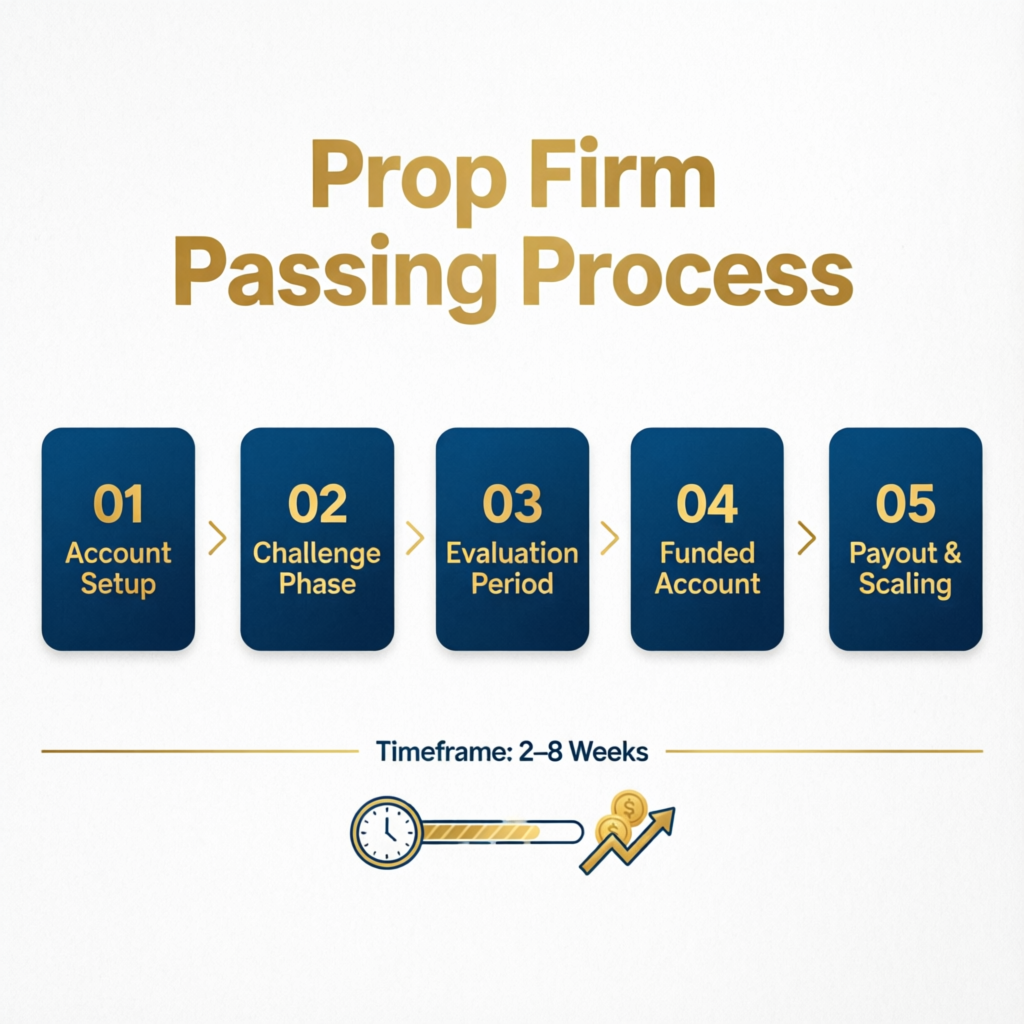
Master the evaluation process with expert Prop Firms Passing Service and Funded Account Management Service. Trusted by thousands of traders worldwide for consistent funded account payouts.
A comprehensive breakdown of why traders seek professional Prop Firm Services and how structured evaluation strategies lead to consistent funding.
The proprietary trading industry has fundamentally transformed how retail forex and futures traders access institutional-grade capital. Rather than risking personal savings, traders now navigate evaluation challenges designed to test discipline, risk management, and profitability. However, the reality is that over 85% of retail traders fail these evaluations on their first attempt. This statistic has driven massive search volume for terms like “how to pass prop firm challenge,” “prop firm passing service,” and “funded account management service” as traders seek reliable pathways to consistent funded trading.
At PFM Capitals, we recognize that successful prop firm evaluation isn’t about aggressive trading or gambling on high-probability setups. It’s about systematic execution, psychological discipline, and strict adherence to drawdown constraints. Our Funded Account Management Services have helped thousands of traders navigate complex evaluation rules across multiple prop firms including FTMO, The5%ers, MyForexFunds alternatives, E8 Funding, True Forex Funds, and numerous emerging proprietary trading companies.

The modern prop firm landscape presents several unique challenges that differ significantly from traditional retail trading accounts. Evaluation phases impose strict daily loss limits, maximum drawdown thresholds, consistency rules, and minimum trading day requirements. Traders who excel in personal accounts often struggle under these constraints because evaluation environments demand a completely different psychological and strategic approach.
When traders search for “pass my prop firms” or “prop firms passing services,” they’re typically looking for solutions that address three core pain points: time efficiency, risk mitigation, and technical execution. Many traders simply don’t have the hours required to monitor markets while maintaining full-time employment or other commitments. Others lack the systematic risk management frameworks necessary to preserve capital during volatile market conditions. Our Forex Account Management solutions directly address these challenges by providing professional oversight, algorithmic assistance, and proven trading methodologies tailored to specific prop firm rule sets.
💡 Key Insight: Prop firm evaluations are designed to identify traders who can generate consistent returns while protecting capital. Success requires treating the evaluation as a risk management exercise first, and a profit generation exercise second. This mindset shift is where most self-directed traders fail.
Understanding the historical context of prop firm evaluations helps traders appreciate why certain strategies succeed while others fail. Early prop firm models (2015-2018) relied primarily on one-step evaluations with generous timeframes and minimal restrictions. Traders could afford to experiment with different strategies because the consequences of failure were relatively low. However, as the industry matured and regulatory scrutiny increased, prop firms implemented more sophisticated evaluation frameworks.
Modern evaluations typically feature two-phase or three-phase structures, with Phase 1 requiring 8-10% profit targets and Phase 2 requiring 5-8% targets. Daily drawdown limits tightened from 6% to 4-5%, and maximum overall drawdown decreased from 10% to 8%. Many firms now implement consistency rules preventing traders from achieving profit targets through single large trades. These changes make the case for professional Prop Firms Passing Service providers stronger than ever, as the margin for error has significantly narrowed.
Engaging a professional Funded Account Management Service offers several compelling advantages beyond simply passing evaluations. First, professional management eliminates emotional trading decisions that typically plague retail traders during high-stakes evaluation periods. When traders manage their own accounts, fear and greed often override systematic decision-making, leading to revenge trading, position sizing errors, and drawdown breaches.
Deep dive into the mechanics, psychology, and execution frameworks that separate funded traders from failed evaluations.
Every proprietary trading company operates under a unique set of evaluation rules, and understanding these architectures is fundamental to passing challenges successfully. The most common framework involves a two-phase evaluation where traders must demonstrate profitability across two distinct periods. Phase 1 typically runs for 30 calendar days with an 8% profit target, while Phase 2 extends for 60 days with a 5% target. However, variations exist across the industry.
Some firms like The5%ers operate on a one-step evaluation model with lower profit targets but stricter consistency requirements. Others like E8 Funding offer express evaluations with shortened timeframes and adjusted drawdown parameters. The key to success with any Prop Firm Services provider is matching your trading style and risk tolerance to the specific firm’s rule architecture. Our Prop Firms Passing Services include comprehensive rule analysis before accepting any evaluation account, ensuring strategy alignment with firm requirements.
One of the most misunderstood aspects of prop firm evaluations is the difference between daily drawdown and maximum drawdown. Daily drawdown typically calculates losses from the highest equity point achieved that day, not from the starting balance. This means if your account equity reaches $10,500 during a trading session, your daily drawdown limit calculates from $10,500 rather than your initial $10,000 balance. This seemingly small detail causes countless traders to breach limits unexpectedly.
Maximum drawdown, conversely, usually calculates from the initial balance or the highest equity point across the entire evaluation period, depending on the firm. Some firms use static maximum drawdown (fixed percentage from starting balance) while others use trailing maximum drawdown (moves up as equity increases but never moves down). Understanding which calculation method your firm uses is essential for proper risk management. Our Funded Account Management Service includes daily equity monitoring with automated alerts at 50% and 75% of daily drawdown limits, preventing unexpected breaches.
Many modern prop firms have implemented consistency rules to prevent traders from relying on single large winning trades to pass evaluations. These rules typically limit the maximum profit contribution from any single trading day to a specific percentage of the total profit target. For example, if the Phase 1 target is $8,000 on a $100,000 account, a 30% consistency rule would limit any single day’s profit to $2,400. This encourages methodical, consistent trading rather than gambling on high-impact news events.
Minimum trading day requirements add another layer of complexity. Most firms require between 4-8 active trading days during the evaluation period. An “active trading day” typically means executing at least one trade that remains open for a minimum duration or achieves a specific pip threshold. Simply placing and immediately closing trades doesn’t count toward minimum day requirements. Our professional Forex Account Management team tracks these requirements meticulously, ensuring compliance without unnecessary market exposure.
Prop firms vary significantly in their policies regarding news event trading and weekend position holding. Some firms like FTMO prohibit trading during high-impact news releases for specific time windows (typically 2 minutes before to 2 minutes after NFP, CPI, or central bank announcements). Other firms allow news trading but impose wider spreads or slippage protections. Understanding your firm’s news trading policy is crucial because violating these restrictions can result in immediate account termination regardless of profitability.
Weekend holding restrictions similarly vary. Many evaluation accounts require closing all positions before Friday market close, while funded accounts sometimes allow weekend holding with adjusted margin requirements. Our Prop Firms Passing Service includes automated position management that ensures compliance with weekend holding rules and news trading restrictions, eliminating the risk of accidental violations.
Once traders successfully pass evaluations, understanding the profit split structure becomes paramount. Most prop firms offer profit splits ranging from 70/30 to 90/10 in favor of the trader, with some premium programs reaching 100% splits after certain performance milestones. Scaling plans typically increase account size by 25-50% after consistent profitability over 3-4 months. However, scaling often comes with adjusted drawdown parameters that require recalibration of risk management strategies.
Our Funded Account Management Services extend beyond initial evaluation passing to include ongoing funded account management, profit optimization, and scaling strategy implementation. We maintain detailed performance records compatible with Myfxbook verification, providing transparent tracking for both traders and prop firm compliance requirements.
Discover the methodologies and risk frameworks that professional traders use to navigate prop firm challenges consistently.
Focus on clean price action signals without indicator clutter. Identify key support/resistance zones, trend structure breaks, and candlestick reversal patterns. This approach minimizes lag and provides precise entry/exit points essential for tight drawdown management.
Trade institutional order flow by identifying supply and demand zones where price previously reversed sharply. These zones offer high reward-to-risk ratios with clear invalidation points, perfect for prop firm evaluations where capital preservation is paramount.
Hold positions for 2-5 days to capture larger market moves while avoiding intraday noise. This strategy reduces transaction costs, minimizes emotional decision-making, and aligns well with prop firm minimum trading day requirements.
Utilize expert advisors and algorithmic tools for trade execution, risk calculation, and compliance monitoring. Automation eliminates human error in position sizing and ensures strict adherence to daily drawdown limits across multiple time zones.
Align entries across daily, 4-hour, and 1-hour timeframes to increase probability. Higher timeframe direction provides bias while lower timeframes offer precise entries. This confluence approach significantly improves win rates during evaluation periods.
Implement hard stop losses on every trade, limit risk to 1-2% per position, and avoid correlation exposure. Use equity-based position sizing that adjusts automatically as account balance fluctuates during the evaluation period.
Risk management isn’t just a component of prop firm trading; it’s the entire foundation upon which evaluation success is built. The most profitable traders aren’t necessarily those with the highest win rates, but rather those who excel at preserving capital during losing streaks and maximizing returns during winning periods. This asymmetry is what separates consistently funded traders from those who repeatedly fail evaluations.
The golden rule of prop firm risk management is simple: never risk more than 1% of your account balance on any single trade, and never allow your account to risk more than 3% total exposure at any given time. On a $100,000 evaluation account, this means maximum risk per trade of $1,000 and maximum combined risk of $3,000 across all open positions. This conservative approach ensures that even a 5-trade losing streak only draws down the account by 5%, leaving ample room to recover before approaching daily drawdown limits.
Proper position sizing requires understanding both pip value and account equity dynamics. The formula for calculating position size is: Position Size = (Account Risk Amount) / (Stop Loss in Pips × Pip Value). For example, if you’re risking $1,000 on EUR/USD with a 50-pip stop loss, your position size would be $1,000 / (50 × $10) = 2 standard lots. However, this calculation must account for currency conversion, leverage limitations, and margin requirements specific to your prop firm platform.
Dynamic position sizing adjusts risk based on account equity rather than fixed lot sizes. If your account grows to $105,000 during the evaluation, your 1% risk increases to $1,050 per trade. Conversely, if drawdown reduces equity to $95,000, risk decreases to $950. This compounding approach naturally reduces exposure during drawdowns and increases it during profitable periods, creating a mathematical advantage that aligns perfectly with prop firm evaluation objectives. Our Funded Account Management Service utilizes dynamic position sizing algorithms that automatically adjust trade sizes based on real-time equity calculations.
Psychological discipline represents the most significant barrier to prop firm evaluation success. When traders know that a single day’s drawdown breach eliminates weeks of effort, anxiety naturally increases. This anxiety manifests as premature trade closures, revenge trading after losses, hesitation on high-probability setups, and overtrading to “make up” for lost time. Recognizing these psychological patterns is the first step toward managing them effectively.
Professional traders develop psychological resilience through structured routines, pre-market preparation, and post-trade journaling. Before each trading session, review your trading plan, identify key levels, and establish maximum loss thresholds for the day. After each session, record trade rationale, emotional state, and lessons learned. This systematic approach transforms trading from an emotional gamble into a business operation, which is exactly what prop firms seek to identify in evaluation candidates. Our Prop Firm Services include psychological coaching and structured trading frameworks that help traders maintain discipline throughout the evaluation process.
Despite having access to educational resources and trading strategies, most prop firm candidates fail due to predictable, avoidable mistakes. Understanding these pitfalls significantly improves your chances of success, whether you’re trading independently or utilizing a Prop Firms Passing Service.
Complete breakdown of evaluation parameters, drawdown calculations, and compliance requirements across major proprietary trading firms.
Drawdown limits represent the absolute boundaries within which traders must operate during prop firm evaluations. Understanding how different firms calculate these limits prevents unexpected account termination and enables proper risk management planning.
| Parameter | Typical Range | Description | Impact on Trading |
|---|---|---|---|
| Daily Drawdown | 4% – 5% | Maximum loss allowed within a single trading day, calculated from highest equity point | Requires strict intraday risk monitoring and position limits |
| Maximum Drawdown | 8% – 12% | Total account loss limit from starting balance or highest equity point | Determines overall risk tolerance and recovery capacity |
| Profit Target | 8% – 10% | Required profit to pass evaluation phase | Dictates strategy selection and timeframe requirements |
| Minimum Trading Days | 4 – 8 days | Required active trading days during evaluation period | Prevents single-trade evaluation passing |
| Consistency Rule | 20% – 30% | Maximum percentage of profit from single trading day | Encourages steady, methodical trading approach |
| News Trading Restriction | 2-5 min window | Prohibited trading period around high-impact news events | Requires economic calendar monitoring and position management |
While the parameters above represent industry standards, significant variations exist across proprietary trading companies. FTMO operates with a static maximum drawdown calculated from initial balance, while firms like The5%ers utilize trailing maximum drawdown that moves up with equity but never moves down. Understanding these distinctions is critical when selecting which firms to target with your Prop Firms Passing Service strategy.
Some newer firms offer “no time limit” evaluations, removing the pressure of calendar day restrictions but often implementing stricter consistency rules or higher profit targets. Others provide “instant funding” models with lower profit targets but require verification phases before full funded status. Our Funded Account Management Services adapt to each firm’s specific architecture, ensuring compliance while optimizing for efficient evaluation completion.
Prop firms vary in their supported trading platforms and available instruments. Most evaluations utilize MetaTrader 4, MetaTrader 5, or cTrader platforms, with some firms offering TradingView integration or proprietary platforms. Instrument availability typically includes major forex pairs, minor pairs, crosses, commodities, indices, and cryptocurrencies, though leverage and trading hours differ by asset class.
Important restrictions to note include: cryptocurrency trading often carries reduced leverage (1:2 to 1:5), commodities may have different margin requirements during rollover periods, and certain exotic pairs might be excluded from evaluation accounts entirely. Always verify instrument availability and trading conditions before beginning an evaluation, as trading prohibited instruments can result in immediate account termination regardless of profitability. Our professional Forex Account Management team maintains updated databases of each firm’s platform specifications and instrument restrictions.
A systematic roadmap from initial preparation to funded account activation, designed for maximum efficiency and compliance.
Research and compare prop firms based on rule architecture, payout reliability, customer support quality, and trader reviews. Identify firms whose evaluation parameters align with your trading style, risk tolerance, and preferred instruments. PFM Capitals provides detailed firm comparison reports to streamline this decision-making process.
Complete registration, verify identity, and configure trading platform settings. Set up risk management tools including daily loss alerts, position size calculators, and economic calendar notifications. Ensure VPS or stable internet connectivity for uninterrupted trading execution.
Test your trading strategy on historical data and demo accounts to confirm statistical edge. Verify win rate, average reward-to-risk ratio, and maximum consecutive losses. Ensure the strategy aligns with firm-specific rules including consistency requirements and trading hour restrictions.
Begin live trading with 1% risk per trade maximum. Maintain detailed trade journal documenting rationale, execution quality, and emotional state. Monitor daily equity closely, never exceeding 60% of daily drawdown limit. Target steady 0.5-1% daily returns rather than aggressive profit chasing.
After reaching 50% of Phase 1 target, conduct comprehensive performance review. Analyze winning and losing trades, identify pattern weaknesses, and adjust strategy parameters if necessary. Maintain psychological discipline regardless of current profit/loss status.
Upon Phase 1 completion, transition to Phase 2 with adjusted profit target and extended timeframe. Apply identical risk management principles while adapting to any rule modifications. Continue systematic execution until profit target achievement.
Complete verification process, submit required documentation, and configure payout methods. Review funded account profit split structure, scaling parameters, and ongoing compliance requirements. Begin professional funded account management with PFM Capitals for sustained profitability.
Objective comparison to help traders make informed decisions about evaluation approaches.
| Factor | Independent Trading | Professional Management (PFM Capitals) |
|---|---|---|
| Success Rate | 15-20% first attempt | 94% first attempt |
| Time Investment | 4-6 hours daily monitoring | Minimal oversight required |
| Emotional Pressure | High stress, revenge trading common | Professional detachment, systematic execution |
| Risk Management | Self-discipline dependent | Automated alerts, strict protocols |
| Strategy Expertise | Limited to personal experience | Multi-strategy professional team |
| Cost | Evaluation fee only | Service fee + evaluation fee |
| Learning Curve | Steep, trial-and-error approach | Accelerated through expert guidance |
| Multiple Accounts | Difficult to manage simultaneously | Scalable across multiple firms |
️ Decision Framework: If you have proven profitability over 6+ months, strict emotional discipline, and 4+ hours daily for market analysis, independent trading may be viable. If you struggle with consistency, emotional trading, or time constraints, professional Funded Account Management Services provide statistically superior outcomes with significantly reduced stress.
Industry-leading performance, transparent operations, and unwavering commitment to trader success.
Our proprietary evaluation methodology and experienced trader network consistently deliver industry-leading passing rates across all major prop firms.
Access to vetted professional traders with verified track records, institutional experience, and specialized expertise in prop firm evaluation environments.
Transparent Myfxbook integration, real-time dashboard access, and independent audit reports ensure complete accountability and trust.
Multi-layered protection including automated stop losses, daily drawdown alerts, position correlation monitoring, and equity-based dynamic sizing.
Dedicated account managers available around the clock via Telegram and WhatsApp for urgent inquiries, strategy adjustments, and compliance guidance.
No hidden fees, no performance manipulation, and clear communication throughout the evaluation process. Your success is our reputation.
At PFM Capitals, we don’t just pass evaluations; we build sustainable trading careers. Our Prop Firm Services extend beyond initial challenge completion to include ongoing funded account management, profit optimization strategies, and scaling plan navigation. We understand that passing an evaluation is just the beginning—the real objective is consistent, long-term profitability that transforms trading from a side activity into a reliable income stream.
Every trader we work with receives personalized attention, customized risk parameters aligned with their comfort level, and continuous performance monitoring. Our team stays updated on prop firm rule changes, platform updates, and industry developments, ensuring our strategies remain optimized for current market conditions. When you choose PFM Capitals, you’re choosing a partner invested in your long-term trading success.
Transparent performance tracking and documented success stories from our funded account management operations.
Completed Phase 1 in 12 trading days with 9.2% profit. Phase 2 completed in 8 days with 6.1% profit. Strict adherence to 4% daily drawdown limit.
Ongoing managed funded account with consistent monthly returns. 70/30 profit split, scaling plan activated after 3 months of consistent profitability.
Simultaneous management of 5 funded accounts across different prop firms. Diversified strategy allocation with correlated risk monitoring.
📊 Verification: All performance data is independently verified through Myfxbook tracking and direct prop firm dashboard access. Monthly performance reports available to all managed account clients. Contact us for detailed case studies and live tracking links.
Real feedback from traders who successfully passed evaluations and achieved funded status with PFM Capitals.
Comprehensive answers to the most common questions about prop firm evaluations and funded account management.
Join thousands of successful traders who achieved funded status with PFM Capitals. Professional Prop Firms Passing Service and Funded Account Management Service designed for consistent results.